
BPC-157 Research Hub · Evidence Overview
BPC-157 research evidence: what has actually been studied?
A structured review of the published human, animal, in-vitro, and analytical evidence—along with the limitations that matter when interpreting it.
Evidence at a glance
Overview
BPC-157 is a synthetic 15-amino-acid peptide described in the literature by the sequence Gly-Glu-Pro-Pro-Pro-Gly-Lys-Pro-Ala-Asp-Asp-Ala-Gly-Leu-Val. For the free-base form, FDA materials list CAS Registry Number 137525-51-0, molecular formula C62H98N16O22, and molecular weight 1419.54. Those identifiers are form-specific: salts, counterions, hydration state, and manufacturing-related impurities can change how a material should be described and tested.
The literature covers several research areas, especially tissue-injury models, gastrointestinal models, angiogenesis-related signaling, tendon-cell behavior, and animal pharmacokinetics. The breadth of topics can make the evidence base appear more mature than it is. Most experiments remain preclinical, and different studies do not necessarily use equivalent materials or analytical specifications.
Research background
A 2025 systematic review of orthopaedic and sports-medicine literature identified 36 eligible studies from 544 screened records. Thirty-five were preclinical and only one was clinical at the review’s June 2024 search cutoff. A small human infusion pilot was published later, in 2025, but it enrolled only two participants. The overall evidence base therefore remains heavily weighted toward animal and laboratory research.
FDA’s 2026 scientific briefing likewise identified important uncertainties in substance identity, characterization, safety, and clinical evidence. FDA noted the absence of a recognized USP–NF monograph and the inconsistent use of the name “BPC-157” across free-base, salt, and derivative forms. This makes analytical documentation—identity, purity, method context, and lot-specific records—especially important when evaluating research materials.
Findings by research area
| Research area | What has been reported | What it does not establish |
|---|---|---|
| Tendon and ligament models | Rat injury models and rat tendon-cell studies reported changes in biomechanical outcomes, cell migration, survival under stress, and signaling markers. | Clinical repair, functional benefit, or safety in humans. |
| Vascular signaling | Cell, chick-membrane, and rat hind-limb studies reported VEGFR2-related signaling and angiogenesis-associated observations. | A validated mechanism or beneficial clinical outcome in people. |
| Gastrointestinal models | Multiple rodent studies reported effects in experimentally induced gastric or intestinal injury models. | Treatment effectiveness for any human gastrointestinal condition. |
| Pharmacokinetics | Distribution, metabolism, and excretion have been studied in rats and beagle dogs. | Human exposure, bioavailability, optimal formulation, or a safe use profile. |
Human data
Retrospective knee-pain report
A 2021 publication described a retrospective chart review and telephone follow-up involving 16 reachable patients with varied knee-pain diagnoses. Twelve had received BPC-157 alone and four had received BPC-157 with another peptide. The authors reported self-described improvement in most participants.
The study had no control group, no randomization, heterogeneous diagnoses, variable follow-up, and no validated measures of function, quality of life, stiffness, or daily activity. The findings therefore represent an uncontrolled patient series and cannot establish causation or efficacy.
Two-participant safety pilot
A 2025 pilot publication reported short-term observations in two adults who had previously been exposed to BPC-157. The authors monitored vital signs, selected laboratory measures, and self-reported adverse effects and reported no measurable adverse changes during the observation period.
With only two participants, no control group, prior exposure, and limited follow-up, the study cannot establish general safety, detect uncommon harms, or define human pharmacokinetics. It should be read as a preliminary observation rather than a safety determination.
What is still missing
The published record lacks adequate randomized, blinded, controlled human trials; validated clinical endpoints; sufficiently large safety cohorts; standardized and independently characterized formulations; and robust human pharmacokinetic data. FDA’s 2026 review concluded that the available clinical information was insufficient to characterize safety for the evaluated uses.
Animal data
Much of the frequently cited BPC-157 literature comes from rodent injury models. In rat Achilles-tendon transection and medial-collateral-ligament transection models, investigators reported differences in biomechanical, functional, macroscopic, and histological outcomes compared with controls. These experiments are useful for developing hypotheses about tissue response, but surgical models in rodents do not reproduce the full biology, dosing context, or outcome priorities of human injury.
Other animal work includes gastrointestinal injury models, hind-limb ischemia models, and pharmacokinetic studies in rats and dogs. A 2022 pharmacokinetic study found that the parent peptide was cleared rapidly in both species and was metabolized into smaller peptide fragments. Those results describe the tested animal systems and formulations; they do not supply human pharmacokinetic parameters.
In-vitro and ex-vivo data
Studies using rat Achilles-tendon fibroblasts reported increased cell migration, spreading, survival under oxidative stress, and changes in FAK–paxillin signaling. One study found that BPC-157 did not directly increase fibroblast proliferation in its MTT assay, an important qualification when summarizing the proposed cellular effects.
Additional experiments reported increased growth-hormone-receptor expression in rat tendon fibroblasts and VEGFR2-related signaling in endothelial systems. These findings suggest testable mechanisms, but concentration, exposure conditions, cell source, assay design, and reproducibility all affect interpretation. A pathway signal in culture is not equivalent to a demonstrated therapeutic mechanism in humans.
Research limitations
- Human evidence is sparse: the available publications are too small and methodologically limited to support firm clinical conclusions.
- Preclinical dominance: positive findings in animals and cultured cells have not been confirmed in adequate human trials.
- Material identity varies: free base, acetate, other derivatives, and incompletely characterized preparations may not be interchangeable.
- Analytical reporting is inconsistent: not every study provides enough information about purity, impurities, stability, or validated assay methods.
- Independent replication is limited: many findings originate from a relatively concentrated set of research groups and model systems.
- Long-term safety is unresolved: the existing human observations are not large or long enough to detect uncommon, delayed, immune-mediated, reproductive, or other risks.
Future research
A credible translational program would first define the exact molecular form and impurity profile, use validated identity and quantitative methods, establish formulation stability, and characterize pharmacokinetics in a staged clinical program. Any human study would also need prospective registration, adequate controls, predefined outcomes, transparent adverse-event monitoring, and sufficient follow-up. Replication by independent groups would strengthen confidence in any reported effect.
References
- U.S. Food and Drug Administration. Evaluation of BPC-157-Related Bulk Drug Substances (BPC-157 Free Base and BPC-157 Acetate) for Inclusion on the 503A Bulks List. FDA briefing document. May 11, 2026.
- Vasireddi N, Hahamyan H, Salata MJ, et al. Emerging Use of BPC-157 in Orthopaedic Sports Medicine: A Systematic Review. HSS J. 2025. doi:10.1177/15563316251355551. PMID: 40756949.
- Lee E, Padgett B. Intra-Articular Injection of BPC 157 for Multiple Types of Knee Pain. Altern Ther Health Med. 2021;27(4):8–13. PMID: 34324435.
- Lee E, Burgess K. Safety of Intravenous Infusion of BPC157 in Humans: A Pilot Study. Altern Ther Health Med. 2025;31(5):20–24. PMID: 40131143.
- He L, Feng D, Guo H, et al. Pharmacokinetics, distribution, metabolism, and excretion of body-protective compound 157 in rats and dogs. Front Pharmacol. 2022;13:1026182. doi:10.3389/fphar.2022.1026182.
- Staresinic M, Sebecic B, Patrlj L, et al. Gastric pentadecapeptide BPC 157 accelerates healing of transected rat Achilles tendon and in vitro stimulates tendocytes growth. J Orthop Res. 2003;21(6):976–983. doi:10.1016/S0736-0266(03)00110-4.
- Cerovecki T, Bojanic I, Brcic L, et al. Pentadecapeptide BPC 157 (PL 14736) improves ligament healing in the rat. J Orthop Res. 2010;28(9):1155–1161. doi:10.1002/jor.21107.
- Chang CH, Tsai WC, Lin MS, Hsu YH, Pang JHS. The promoting effect of pentadecapeptide BPC 157 on tendon healing involves tendon outgrowth, cell survival, and cell migration. J Appl Physiol. 2011;110(3):774–780. doi:10.1152/japplphysiol.00945.2010.
- Chang CH, Tsai WC, Hsu YH, Pang JHS. Pentadecapeptide BPC 157 enhances the growth hormone receptor expression in tendon fibroblasts. Molecules. 2014;19(11):19066–19077. doi:10.3390/molecules191119066.
- Hsieh MJ, Liu HT, Wang CN, et al. Therapeutic potential of pro-angiogenic BPC157 is associated with VEGFR2 activation and up-regulation. J Mol Med. 2017;95(3):323–333. doi:10.1007/s00109-016-1488-y.
Related Research Library articles
- How to read a Certificate of Analysis without overreading it
- HPLC basics: what a chromatogram can and cannot tell you
- Mass spectrometry basics: identity evidence, m/z, and method context
Article record
- Research question
- What does the published evidence on BPC-157 show across human, animal, in-vitro, and analytical research?
- Evidence cutoff
- July 14, 2026
- Article status
- Published educational research summary; not independently peer reviewed
- Author
- JD BioWorks Research Library
- Editorial review
- JD BioWorks Research Library
- Planned review cycle
- At least annually, or sooner if material human evidence or regulatory information changes
This article summarizes published research for educational and laboratory-information purposes. It is not medical advice, does not provide instructions for personal use, and does not establish that any material is safe or effective for human or veterinary use.
Related Research Materials
BPC-157
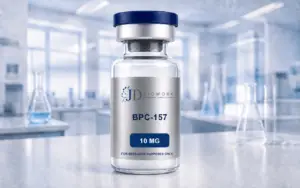
BPC-157 10 mg research material. Lot-specific analytical documentation is available below.
View Research Material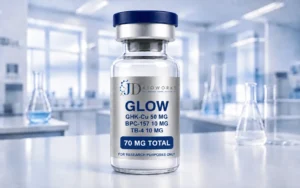
GLOW 70 mg Research Blend
GLOW 70 mg research blend. Labeled formulation: GHK-Cu 50 mg, BPC-157 10 mg, and TB-4 10 mg. Lot-specific…
View Research Material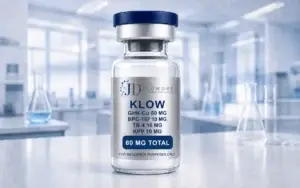
KLOW 80 mg Research Blend
KLOW 80 mg research blend labeled GHK-Cu 50 mg, BPC-157 10 mg, TB-500 10 mg, and KPV 10…
View Research Material