
CJC-1295 No DAC Research Hub · Evidence Overview
CJC-1295 No DAC research evidence: what has actually been studied?
A careful review of growth-hormone-releasing-hormone analogue research—and why “No DAC” must not be conflated with long-acting CJC-1295.
Evidence at a glance
Overview
“CJC-1295” is often used loosely for more than one growth-hormone-releasing-hormone analogue. The best-known clinical studies evaluated a long-acting molecule with a drug-affinity-complex component that forms a covalent bond with albumin. Products marketed as “CJC-1295 No DAC” are generally intended to denote a shorter-acting analogue without that component. These are not interchangeable research identities.
Research background
Two randomized studies published in 2006 evaluated long-acting CJC-1295 in healthy adults and reported sustained changes in growth hormone and IGF-I. A follow-up analysis examined pulsatile secretion under continuous stimulation. Those publications are valuable for the specific molecule studied, but they should not be cited as direct human evidence for a different non-DAC material.
Findings by research area
| Research area | What has been reported | What it does not establish |
|---|---|---|
| Long-acting CJC-1295 | Randomized healthy-volunteer studies reported prolonged pharmacokinetic and pharmacodynamic effects. | Effects of a non-DAC analogue. |
| No-DAC identity | Supplier terminology commonly distinguishes shorter-acting material from DAC-conjugated CJC-1295. | A universally standardized chemical identity. |
| GHRH biology | Analogue research can examine pituitary GH release and downstream IGF-I. | Clinical benefit, safety, or dosing for an unstudied material. |
Human data
The Teichman studies enrolled healthy adults in randomized, placebo-controlled, ascending-dose protocols using long-acting CJC-1295. They reported sustained increases in measured GH and IGF-I and an estimated multiday half-life. Because albumin binding is central to that pharmacokinetic profile, the results cannot be used to describe the half-life or exposure of a “No DAC” material. Direct controlled human data for the exact material represented on this site were not identified in the primary literature reviewed for this summary.
Animal data
Animal GHRH-analogue studies can explore endocrine signaling, growth, and exposure, but small changes in sequence or conjugation can substantially alter stability and duration. Each test article therefore requires exact sequence and form documentation.
In-vitro and analytical context
Receptor and pituitary-cell assays can compare agonist activity. They cannot establish in-vivo exposure, endocrine pulsatility, or safety, and they do not substitute for mass-spectrometric identity and quantitative purity testing.
Research limitations
- The label “CJC-1295 No DAC” is not used consistently across the literature and market.
- Frequently cited clinical studies examined a different, long-acting albumin-binding molecule.
- Human pharmacokinetics, safety, and outcomes for the exact non-DAC material remain inadequately characterized.
- Combination with ipamorelin creates a separate test article and evidence question.
Future research
Research should begin with unambiguous sequence and molecular-form definitions, followed by validated analytical characterization, receptor pharmacology, pharmacokinetics, and staged controlled studies of the exact test article.
Primary references
- Teichman SL, et al. Prolonged stimulation of GH and IGF-I secretion by CJC-1295 in healthy adults. J Clin Endocrinol Metab. 2006. doi:10.1210/jc.2005-1536.
- Ionescu M, Frohman LA. Pulsatile secretion of GH persists during continuous stimulation by CJC-1295. J Clin Endocrinol Metab. 2006. PMID:17018654.
Related Research Library articles
- How to read a Certificate of Analysis without overreading it
- HPLC basics: what a chromatogram can and cannot tell you
- Mass spectrometry basics: identity evidence, m/z, and method context
Article record
- Research question
- What does the published evidence on CJC-1295 No DAC show across human, animal, and laboratory research?
- Evidence cutoff
- July 15, 2026
- Article status
- Published educational research summary; not independently peer reviewed
- Author
- JD BioWorks Research Library
- Editorial review
- JD BioWorks Research Library
- Planned review cycle
- At least annually, or sooner if material evidence or regulatory information changes
This article summarizes published research for educational and laboratory-information purposes. It is not medical advice, does not provide instructions for personal use, and does not establish that any material is safe or effective for human or veterinary use.
Related Research Materials
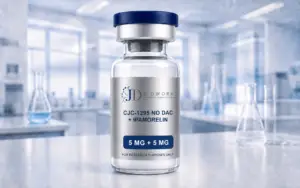
CJC-1295 No DAC + Ipamorelin
CJC-1295 No DAC + Ipamorelin, 5 mg + 5 mg. Lot-specific analytical documentation is available below.
View Research Material