
GHK-Cu Research Hub · Evidence Overview
GHK-Cu research evidence: what has actually been studied?
A structured review of glycyl-L-histidyl-L-lysine copper research across biochemical, cell, animal, and limited human contexts.
Evidence at a glance
Overview
GHK is the tripeptide glycyl-L-histidyl-L-lysine. GHK-Cu refers to its copper(II) complex. The distinction matters because free peptide, copper salt, copper-loaded complex, and formulated products may have different analytical and biological properties. Research spans copper coordination, cell and gene-expression assays, extracellular-matrix measurements, and wound models.
Research background
GHK was originally identified in human plasma, and later studies examined the copper complex as a signaling and tissue-response molecule. The literature is heterogeneous: experimental systems range from purified components to cultured cells, rodent wounds, and topical human formulations. Results should be grouped by test article and model rather than summarized as one unified clinical claim.
Findings by research area
| Research area | What has been reported | What it does not establish |
|---|---|---|
| Copper coordination | Biochemical studies examine metal binding and structure. | Biological activity of every preparation. |
| Cell and tissue assays | Studies report changes in matrix-related markers, inflammatory signaling, and cell behavior. | Clinical repair or safety in people. |
| Animal wound models | Rat studies reported changes in collagen, glycosaminoglycans, protein, and DNA within wound chambers. | Outcomes from human use or another route. |
Human data
Human evidence is smaller and more formulation-dependent than the broad promotional summaries often imply. Topical cosmetic and wound-related studies cannot be generalized to other formulations or routes. Study size, blinding, comparator quality, endpoint selection, and whether the tested formulation was independently characterized all affect interpretation.
Animal data
In a rat wound-chamber experiment, GHK-Cu was associated with concentration-dependent changes in dry weight, DNA, protein, collagen, and glycosaminoglycan content. This supports investigation of local tissue responses in that model, not a conclusion about human efficacy or systemic safety.
In-vitro and analytical context
Cell-culture and molecular studies have examined gene expression, cytokine-related pathways, oxidative stress, and matrix biology. Copper itself is biologically active, so controls for free copper, peptide alone, complex stoichiometry, and concentration are essential.
Research limitations
- The literature uses different formulations and delivery systems.
- Many findings are preclinical or use surrogate laboratory endpoints.
- Copper loading and free-copper content are not always reported consistently.
- Human studies are not sufficient to generalize across routes or preparations.
Future research
Future research should report peptide identity, copper stoichiometry, free-copper content, stability, and formulation; use appropriate copper and peptide controls; preregister human outcomes; and replicate findings independently.
Primary references
Related Research Library articles
- How to read a Certificate of Analysis without overreading it
- HPLC basics: what a chromatogram can and cannot tell you
- Mass spectrometry basics: identity evidence, m/z, and method context
Article record
- Research question
- What does the published evidence on GHK-Cu show across human, animal, and laboratory research?
- Evidence cutoff
- July 15, 2026
- Article status
- Published educational research summary; not independently peer reviewed
- Author
- JD BioWorks Research Library
- Editorial review
- JD BioWorks Research Library
- Planned review cycle
- At least annually, or sooner if material evidence or regulatory information changes
This article summarizes published research for educational and laboratory-information purposes. It is not medical advice, does not provide instructions for personal use, and does not establish that any material is safe or effective for human or veterinary use.
Related Research Materials
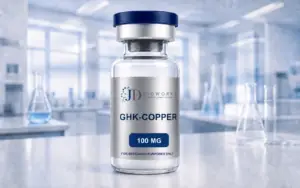
GHK-Cu
GHK-Cu 100 mg research material. Lot-specific analytical documentation is available below.
View Research Material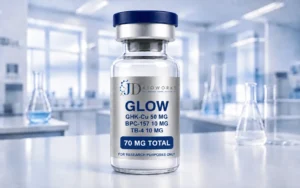
GLOW 70 mg Research Blend
GLOW 70 mg research blend. Labeled formulation: GHK-Cu 50 mg, BPC-157 10 mg, and TB-4 10 mg. Lot-specific…
View Research Material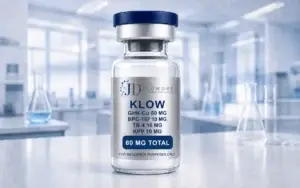
KLOW 80 mg Research Blend
KLOW 80 mg research blend labeled GHK-Cu 50 mg, BPC-157 10 mg, TB-500 10 mg, and KPV 10…
View Research Material