

Epitalon Research Hub · Evidence Overview
Epitalon research evidence: what has actually been studied?
A source-based review of telomere experiments, cell and animal models, and the current U.S. regulatory context—with study design and limitations kept in view.
Evidence at a glance
What is Epitalon?
Epitalon is a four-amino-acid peptide with the sequence alanine-glutamic acid-aspartic acid-glycine, commonly abbreviated AEDG. The name also appears as Epithalon or Epithalone. FDA’s Global Substance Registration System identifies Epitalon as an ingredient substance with UNII O65P17785G and molecular formula C14H22N4O9. A UNII records chemical identity; it does not indicate that a drug has been reviewed or approved.
The literature spans several distinct research questions: telomerase and telomere length in cultured cells, gene-expression changes during cell differentiation, oxidative-stress markers in mouse oocytes, and older exploratory work. These evidence types answer different questions and should not be combined into a single claim about longevity, treatment, or clinical use.
Evidence map
| Research area | What was studied | Key limitation |
|---|---|---|
| Telomerase and telomeres | A 2003 cell-culture report examined telomerase activity and telomere length in human somatic cells exposed to Epithalon. | Cell-culture results do not demonstrate organism-level longevity or clinical benefit. |
| Human-derived cell lines | A 2025 study measured telomere length, hTERT expression, telomerase activity, and alternative lengthening of telomeres in normal and breast-cancer cell lines. | In vitro findings, including cancer-cell responses, require careful interpretation and do not establish human safety. |
| Stem-cell differentiation | A 2020 study assessed neurogenic-marker gene and protein expression in human gingival mesenchymal stem cells. | Marker expression is a laboratory endpoint, not a demonstrated neurological outcome. |
| Mouse-oocyte model | A 2022 in vitro study measured reactive oxygen species, spindle defects, mitochondrial markers, and apoptosis during post-ovulatory aging. | An isolated mouse-oocyte model cannot establish reproductive or anti-aging effects in people. |
| U.S. regulatory review | FDA materials in 2026 discussed Epitalon-related bulk substances in the compounding context and evaluated a nominated use for insomnia. | Advisory review and substance identification are not FDA approval. |
What the telomere studies reported
A 2003 report by Khavinson and colleagues exposed telomerase-negative human fetal fibroblast cultures to Epithalon. The authors reported expression of the catalytic telomerase subunit, telomerase activity, and telomere elongation. This study is frequently cited in discussions of Epitalon, but its design was a cell-culture experiment. It did not test whether the peptide extends human lifespan, improves health outcomes, or has an acceptable safety profile.
A 2025 Biogerontology paper revisited related questions with additional measurements. Researchers treated normal mammary epithelial cells, normal fibroblasts, and two breast-cancer cell lines. They reported dose-dependent telomere-length changes in normal cells alongside hTERT and telomerase upregulation. In the cancer-cell lines, telomere lengthening was associated with alternative lengthening of telomeres, or ALT, activity. The article later received a published correction, which should be read with the original report.
These results refine hypotheses about cellular pathways, but they also illustrate why mechanism claims require caution. Telomere maintenance differs among cell types, and a result in a cultured population does not predict whole-organism aging, disease risk, or therapeutic benefit.
Other cell and animal models
A 2020 study used human gingival mesenchymal stem cells to examine neurogenic differentiation markers. The authors reported increases in several markers and related messenger RNA after AEDG exposure, alongside molecular-modeling work involving histones. This supports a narrow laboratory observation about marker expression. It does not establish that Epitalon changes neurological function in living humans.
In 2022, Yue and colleagues tested Epitalon in an in vitro mouse-oocyte aging model. At the concentration studied, the authors reported lower reactive oxygen species, fewer spindle abnormalities, changes in mitochondrial measures, and reduced apoptosis at selected time points. Because the work used isolated mouse oocytes under experimental conditions, it should be treated as a model-specific result rather than evidence of fertility, reproductive, or anti-aging benefit in people.
What is missing from the clinical evidence base
The sources reviewed here do not provide a modern, independently replicated body of randomized human trials establishing Epitalon’s safety, efficacy, pharmacokinetics, or dose-response relationships. Human-derived cells are not the same as human participants, and older exploratory literature cannot substitute for contemporary controlled trials with transparent methods and clinically meaningful endpoints.
Researchers should also distinguish Epitalon from Epithalamin, a pineal extract studied in some older publications. A result involving an extract does not automatically apply to the synthetic AEDG tetrapeptide. Identity, composition, dose, route, and analytical characterization all matter when comparing studies.
Current U.S. regulatory context
FDA’s 2026 Pharmacy Compounding Advisory Committee materials identified Epitalon free base and Epitalon acetate among bulk drug substances discussed for the 503A Bulks List, with insomnia as the nominated use evaluated. That discussion did not itself make Epitalon an approved drug.
FDA’s current safety-risk page lists Epitalon among nominated but withdrawn bulk drug substances and notes potential immunogenicity concerns for certain compounded routes because of aggregation and peptide-related impurities. The agency also states that it lacks sufficient safety-related information to know whether Epitalon would cause harm when administered to humans.
An earlier orphan-drug record for retinitis pigmentosa is listed as withdrawn or revoked and explicitly states that Epitalon was not FDA approved for that orphan indication. Orphan designation records, advisory-committee discussion, and substance registry entries should never be presented as proof of approval.
Analytical and documentation considerations
For laboratory procurement, the compound name alone is not enough to establish material identity. A defensible review should connect the vial label and lot number to a lot-specific Certificate of Analysis and evaluate what each analytical method actually measures. HPLC purity, retention-time identity, and net peptide content are related but distinct results.
- Confirm the named material, labeled quantity, lot number, and report identifier.
- Review the analytical method, acceptance criteria, chromatogram, and measured net content.
- Check whether identity is directly addressed rather than inferred from purity alone.
- Retain the original laboratory report and its verification information with the research record.
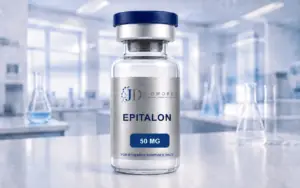
For JD BioWorks lot 2026-002, the published ILS Laboratories report identifies Epitalon, a labeled quantity of 50 mg, 97.14% peptide purity, 52.1 mg net peptide content, and identity confirmed by HPLC retention-time matching. Those results describe the submitted sample only; they are not evidence of clinical safety or effectiveness.
Major limitations in the evidence base
- Much of the accessible evidence is in vitro or animal research.
- Several frequently cited publications come from a concentrated group of investigators, increasing the importance of independent replication.
- Telomere and biomarker changes are surrogate laboratory endpoints, not proof of longer life or improved health.
- Material identity and study comparability can be complicated by naming differences and by confusion between Epitalon and pineal extracts.
- Controlled human evidence, pharmacokinetics, long-term safety data, and validated administration standards remain insufficient.
Verified sources
- Khavinson VK, Bondarev IE, Butyugov AA. Epithalon peptide induces telomerase activity and telomere elongation in human somatic cells. Bull Exp Biol Med. 2003;135(6):590-592. PubMed PMID 12937682.
- Al-Dulaimi S, Thomas R, Matta S, Roberts T. Epitalon increases telomere length in human cell lines through telomerase upregulation or ALT activity. Biogerontology. 2025;26(5):178. PubMed PMID 40908429; see also the published correction.
- Khavinson V, et al. AEDG Peptide (Epitalon) Stimulates Gene Expression and Protein Synthesis during Neurogenesis: Possible Epigenetic Mechanism. Molecules. 2020;25(3):609. PubMed PMID 32019204.
- Yue X, et al. Epitalon protects against post-ovulatory aging-related damage of mouse oocytes in vitro. Aging (Albany NY). 2022;14(7):3191-3202. PubMed PMID 35413689.
- U.S. Food and Drug Administration. Global Substance Registration System: Epitalon.
- U.S. Food and Drug Administration. Certain Bulk Drug Substances for Use in Compounding That May Present Significant Safety Risks.
- U.S. Food and Drug Administration. July 23-24, 2026 Pharmacy Compounding Advisory Committee meeting.
- U.S. Food and Drug Administration. Orphan Drug Designations and Approvals: Epitalon.
Research record
- Compound
- Epitalon (Epithalon)
- Sequence
- Ala-Glu-Asp-Gly (AEDG)
- UNII
- O65P17785G
- Evidence reviewed
- Human-derived cell lines, stem-cell assays, mouse-oocyte model, FDA regulatory records
- Review date
- September 8, 2026
This article is an educational summary for qualified laboratory and analytical research. It is not medical advice and does not provide instructions for human or veterinary use. JD BioWorks materials are not for injection, ingestion, administration, application, or other use in humans or animals.
Related Research Materials
Epitalon
Epitalon 50 mg research material. Lot-specific analytical documentation is available below.
View Research Material