
GLOW Research Blend: Analytical Identity, Composition, and Study Limits
An evidence-focused guide to the GLOW 70 mg research blend, its lot-specific HPLC results, component identities, measured content, and the limits of interpreting a three-peptide mixture.
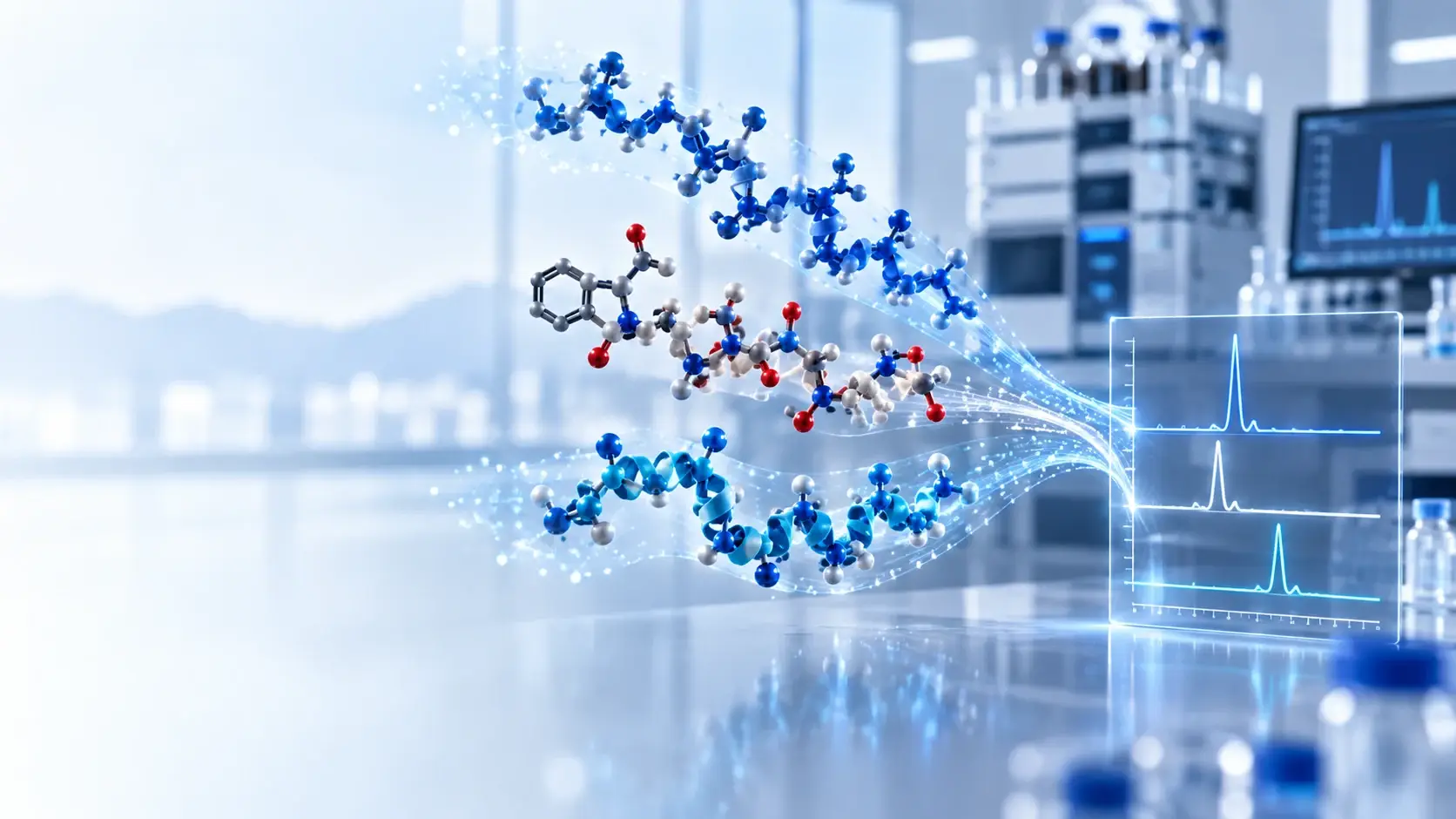
GLOW research blend is a three-component laboratory research material containing labeled amounts of GHK-Cu, BPC-157, and TB-4. This guide explains what the current lot-specific analytical report establishes, what the individual research literature can and cannot tell investigators, and why a blended material must be evaluated as its own test article.
What the GLOW name identifies
On JD BioWorks, GLOW identifies a specific 70 mg labeled research blend: GHK-Cu 50 mg, BPC-157 10 mg, and TB-4 10 mg. The name does not establish a universal formulation across suppliers. Researchers should record the exact product, labeled composition, lot number, and certificate used in each experiment rather than treating every product called “GLOW” as interchangeable.
Current lot analytical snapshot
| Field | Verified report value |
|---|---|
| Product / lot | GLOW 70 mg / Lot 2026-003 |
| Certificate | COA-2026-QS7JFB |
| Laboratory / date | ILS Laboratories / September 22, 2026 |
| Method | Blend purity, identity, and quantitation by HPLC |
| Peptide purity | 99.65% — Pass |
| Identity | GHK-Cu, BPC-157, and TB-4 confirmed — Pass |
| Measured net blend content | 72.51 mg |
| Component results | GHK-Cu 52.21 mg; BPC-157 10.30 mg; TB-4 10.01 mg |
| Fentanyl screen | Not detected — Pass |
View the complete lot-specific Certificate of Analysis.
Identity, purity, and content answer different questions
Identity asks whether the analytical signals are consistent with the named components. Purity estimates the proportion of detected peptide material represented by the target peaks under the stated method. Net content estimates how much peptide material was measured. A high purity result does not replace identity or content testing, and none of these results alone establishes sterility, endotoxin level, stability after opening, or performance in a particular experimental system.
Because this is a mixture, researchers should preserve the entire report with their records. A single headline percentage cannot describe the component ratio, total content, analytical method, and scope of testing.
Research context for the individual components
GHK-Cu
GHK-Cu is a copper-binding tripeptide studied in cell-culture and animal models. A primary fibroblast study reported concentration-dependent changes in glycosaminoglycan synthesis, while a separate rat wound-chamber experiment reported changes in extracellular-matrix measures. These findings concern defined experimental systems and do not establish the behavior of this three-component blend. See the primary studies in Life Sciences and the Journal of Clinical Investigation.
BPC-157
BPC-157 has been examined largely in preclinical systems. One primary study using rat Achilles-tendon fibroblasts reported changes in growth-hormone-receptor expression and downstream cell responses under the study conditions. That experiment was conducted on isolated cells and does not validate a human use, a blended formulation, or a commercial product. See the primary tendon-fibroblast study.
TB-4
The certificate uses the identity label TB-4, referring to thymosin beta-4. Primary endothelial-cell work reported effects on directional migration in defined in-vitro and experimental assays. Those findings are specific to thymosin beta-4 and the reported models; they should not be treated as proof of a combined GHK-Cu/BPC-157/TB-4 effect. See the primary endothelial migration study.
Why a blend requires its own study design
Combining three analytes changes more than the label. A sound protocol should address the component ratio, vehicle, concentration, assay timing, controls, replicate count, detection limits, and potential analytical interference. Results from an individual component cannot be assumed to predict the mixture, and results from one blend ratio cannot automatically be generalized to another.
- Document the lot number and COA before the material enters the workflow.
- Use controls that can distinguish mixture effects from component-specific effects.
- Predefine acceptance criteria and the statistical analysis plan.
- Record handling conditions, time points, and analytical instrument parameters.
- Avoid interpreting a chromatographic purity result as evidence of biological efficacy.
Limits of the current certificate
The current report supports the listed identity, purity, content, and fentanyl-screen results for Lot 2026-003 under the methods shown. It is lot-specific and should not be generalized to future lots. Unless a report explicitly includes a test, it should not be read as evidence for sterility, endotoxin, residual solvents, long-term stability, or suitability for any unlisted application.
Research record checklist
- Product: GLOW 70 mg Research Blend
- Lot: 2026-003
- COA: COA-2026-QS7JFB
- Labeled ratio: GHK-Cu 50 mg / BPC-157 10 mg / TB-4 10 mg
- Independent report date: September 22, 2026
- Study purpose, controls, endpoints, and exclusion criteria
Researchers can review the GLOW 70 mg product record for the current lot documentation and availability.
Primary sources and documentation
- ILS Laboratories. Certificate of Analysis COA-2026-QS7JFB, Lot 2026-003, September 22, 2026.
- Maquart FX, et al. Stimulation of sulfated glycosaminoglycan synthesis by GHK-Cu. Life Sciences. 1992. PMID 1522753.
- Maquart FX, et al. In vivo stimulation of connective tissue accumulation by GHK-Cu in rat experimental wounds. J Clin Invest. 1993. PMID 8227353.
- Chang CH, et al. BPC 157 and growth-hormone-receptor expression in tendon fibroblasts. Molecules. 2014. PMID 25415472.
- Malinda KM, et al. Thymosin beta-4 stimulates directional migration of human endothelial cells. FASEB Journal. 1997. PMID 9194528.
Last reviewed September 22, 2026. For qualified laboratory research only. Not for human or veterinary use.
Related Research Materials
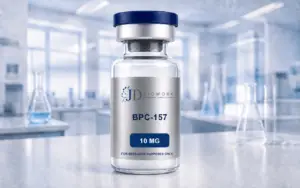
BPC-157
BPC-157 10 mg research material. Lot-specific analytical documentation is available below.
View Research Material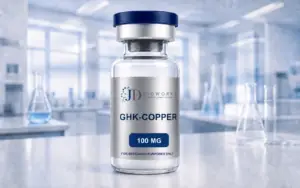
GHK-Cu
GHK-Cu 100 mg research material. Lot-specific analytical documentation is available below.
View Research Material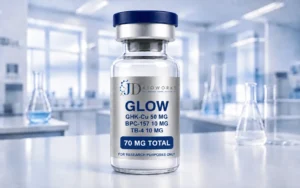
GLOW 70 mg Research Blend
GLOW 70 mg research blend. Labeled formulation: GHK-Cu 50 mg, BPC-157 10 mg, and TB-4 10 mg. Lot-specific…
View Research Material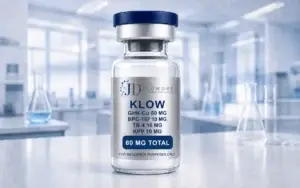
KLOW 80 mg Research Blend
KLOW 80 mg research blend labeled GHK-Cu 50 mg, BPC-157 10 mg, TB-500 10 mg, and KPV 10…
View Research Material