
How Should Lyophilized Research Peptides Be Stored?
The concise answer
Lyophilized research peptides should be kept sealed, dry, protected from light, and stored at the temperature specified in the product documentation. For longer-term laboratory storage, many peptide standards are kept frozen, but there is no scientifically defensible temperature or shelf life that applies to every peptide. Sequence, formulation, container closure, residual moisture, and validation data all matter. Once a peptide is dissolved, it is generally more vulnerable to chemical change, aggregation, adsorption, and microbial contamination.
The safest rule is simple: follow the supplier’s lot-specific storage instructions and certificate documentation. Do not substitute a generic internet storage chart for product-specific stability data.
Why are peptides commonly lyophilized?
Lyophilization, or freeze-drying, removes most of the water from a peptide preparation under controlled conditions. Because water participates in several degradation pathways, a properly developed dry formulation can be more stable than the same peptide in solution.
That does not make a lyophilized peptide indestructible. Residual moisture, oxygen, light, heat, and the peptide’s own amino-acid sequence can still affect stability. Packaging and formulation also matter: two vials containing the same named peptide are not automatically supported by the same shelf life if their excipients, moisture levels, manufacturing processes, or container systems differ.
The five storage factors that matter most
1. Temperature
Lower temperatures can slow many chemical reactions, which is why frozen storage is often used for long-term peptide standards. A widely cited laboratory consensus paper recommends storage between −20°C and −80°C for lyophilized peptides held longer than six months, while emphasizing that stability remains peptide-dependent.
That range is not a universal label instruction. A specific vial may call for refrigeration, frozen storage, or another validated condition. The documented condition for the actual material should take priority.
2. Moisture
Water can increase molecular mobility and enable reactions such as hydrolysis. Keep the vial tightly sealed and minimize unnecessary exposure to humid air. A practical laboratory precaution is to allow a cold, sealed vial to approach room temperature before opening it. This helps reduce condensation on the material or inside the container.
If a vial arrives with a damaged seal, visible moisture, or an abnormal cake appearance, quarantine it and follow the supplier’s quality process instead of assuming that it remains suitable for research.
3. Light
Some amino-acid residues and formulations are susceptible to photochemical change. Protect peptide vials from direct sunlight and unnecessary laboratory light, especially when the supplier specifies light protection. Amber glass, an opaque secondary container, or a closed storage box may help, but these measures do not replace validated packaging requirements.
4. Oxygen
Oxidation is a recognized peptide degradation pathway. Methionine, cysteine, tryptophan, and other residues can be particularly relevant depending on sequence and conditions. Keep containers closed, avoid unnecessary headspace exchange, and do not transfer material repeatedly without a documented reason.
5. Freeze-thaw cycles
Repeated temperature cycling can concentrate solutes during freezing and contribute to oxidation, aggregation, or other instability after reconstitution. Plan aliquots when the protocol and material allow it, and log each removal from controlled storage. Avoid repeatedly warming and refreezing the same sample merely for convenience.
Is a reconstituted peptide less stable?
Often, yes—but the degree varies substantially by peptide and formulation.
In solution, peptides may be exposed to hydrolysis, oxidation, deamidation, aggregation, adsorption to container surfaces, and microbial growth. Stability can change with pH, concentration, buffer composition, excipients, container material, light exposure, temperature, and agitation. For that reason, a universal claim such as “all reconstituted peptides last 30 days” is not evidence-based.
Reconstitution also creates a new handling state. The solvent, target concentration, analytical purpose, aseptic requirements, and storage container should be defined by the research protocol. Do not infer suitability for injection or human use from laboratory handling information.
Can visual inspection confirm peptide quality?
No. Visual inspection can identify obvious problems—such as a cracked vial, failed seal, unexpected discoloration, visible particles, or a changed lyophilized cake—but a normal appearance cannot prove identity, purity, concentration, sterility, or potency.
Peptide degradation may be invisible. Depending on the research question, appropriate assessment can require validated analytical methods such as chromatography and mass spectrometry, plus peptide-specific stability-indicating tests. Appearance is a screening observation, not a certificate of quality.
A practical laboratory storage checklist
- Verify the storage condition on the product page, label, certificate of analysis, or supplied technical document.
- Record the lot number, receipt date, storage location, and required temperature.
- Keep the original container sealed and protected from light and moisture.
- Allow a cold sealed vial to equilibrate before opening when condensation is a concern.
- Minimize time outside controlled storage.
- Avoid repeated freeze-thaw cycles and unnecessary transfers.
- Use calibrated temperature monitoring and document excursions.
- Quarantine material after a seal failure, unexplained appearance change, or unassessed temperature excursion.
- Never assign or extend a shelf life without stability data for that material and container system.
What should a lab do after a temperature excursion?
Do not automatically discard the material, and do not automatically assume it is unaffected. Record the highest and lowest observed temperatures, duration, number of excursions, packaging condition, and whether the vial remained sealed. Then compare the event with available stability data or request a documented assessment from the supplier.
The FDA explains that expiration dates are supported by stability testing under labeled storage conditions. The same principle applies to sound research decisions: conclusions about continued suitability should come from evidence, not guesswork.
Frequently asked questions
Should every lyophilized peptide be stored at −20°C?
No. Frozen storage is common for many peptide standards, especially over longer periods, but peptide sequence, formulation, packaging, and supporting data determine the correct condition. Follow the documentation for the specific material.
Can a peptide be refrozen after it is dissolved?
Only if a validated protocol supports it. Repeated freeze-thaw cycles can damage some peptide preparations. If frozen solution storage is part of the method, single-use aliquots may reduce cycling, but the correct approach remains peptide-specific.
Does an intact lyophilized cake prove the peptide is still good?
No. It is useful visual information, but it cannot establish identity, purity, or activity. Chemical degradation can occur without an obvious visual change.
Can the expiration date be extended because the vial stayed frozen?
Not without supporting stability data. Cold storage alone does not justify an invented or extended expiration date.
The bottom line
Good peptide storage is controlled, documented, and product-specific. Keep lyophilized material sealed, dry, protected from light, and at its documented temperature; limit handling and temperature cycling; and treat unsupported universal shelf-life tables with caution. When a study depends on peptide integrity, analytical verification and lot-specific documentation are more reliable than appearance or internet rules of thumb.
Explore the JD BioWorks Research Library for compound-specific evidence summaries, including BPC-157, retatrutide, and MOTS-c.
Sources
Zapadka KL, et al. Factors affecting the physical stability (aggregation) of peptide therapeutics. Interface Focus. 2017.
Hoofnagle AN, et al. Recommendations for the generation, quantification, storage and handling of peptides used for mass spectrometry-based assays. Clinical Chemistry. 2016.
Strategies for overcoming protein and peptide instability in biodegradable drug delivery systems. Acta Pharmaceutica Sinica B. 2023.
U.S. Food and Drug Administration. Expiration Dates—Questions and Answers.
U.S. Food and Drug Administration. Q5C: Stability Testing of Biotechnological/Biological Products.
Research-use disclaimer: This article concerns laboratory handling concepts and is provided for educational purposes. It is not medical advice, dosing guidance, or a substitute for product-specific documentation. JD BioWorks materials are intended for research use only and are not for human or veterinary use.
Related Research Materials
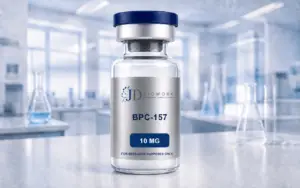
BPC-157
BPC-157 10 mg research material. Lot-specific analytical documentation is available below.
View Research Material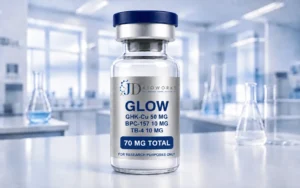
GLOW 70 mg Research Blend
GLOW 70 mg research blend. Labeled formulation: GHK-Cu 50 mg, BPC-157 10 mg, and TB-4 10 mg. Lot-specific…
View Research Material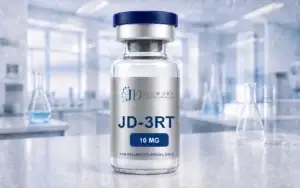
JD-3RT
JD-3RT research material in 10 mg, 20 mg, 30 mg, and 40 mg labeled quantities. Select a quantity…
View Research Material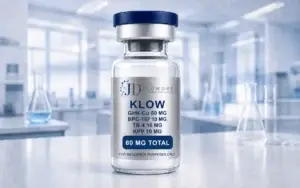
KLOW 80 mg Research Blend
KLOW 80 mg research blend labeled GHK-Cu 50 mg, BPC-157 10 mg, TB-500 10 mg, and KPV 10…
View Research Material