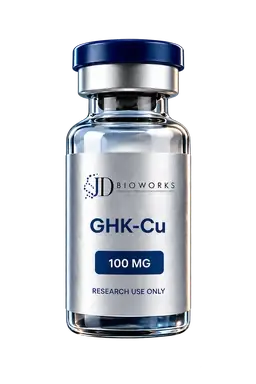

How to Read a Multi-Peptide Blend COA: KLOW 80 mg
A multi-peptide blend Certificate of Analysis should be read as a set of separate analytical questions—not as a single “pass” number. The KLOW 80 mg lot 2026-002 report provides a useful example because it records purity, blend identity, component quantitation, net blend content, and a fentanyl screen in one lot-specific document.
This guide explains what those fields mean, what the reported results establish, and what they do not establish. KLOW and all JD BioWorks materials are offered for qualified laboratory research only—not for human or veterinary use.
Verified KLOW 80 mg report at a glance
| Report field | Lot 2026-002 result | How to interpret it |
|---|---|---|
| Certificate | COA-2026-SIWQ7_ | Identifier printed on the laboratory report |
| Laboratory | ILS Laboratories | Third-party testing laboratory named by the report |
| Analysis date | August 17, 2026 | Date associated with the reported analysis |
| Peptide purity | 99.91% — PASS | Relative chromatographic purity for the analyzed peptide signal |
| Net blend peptide content | 85.65 mg | Reported total measured peptide content for the tested vial |
| Identity | GHK-Cu + BPC-157 + TB-4 + KPV confirmed by HPLC-RTM | Reported chromatographic retention-time match for the listed blend components |
| Fentanyl screen | Not detected — PASS | No fentanyl was detected under the report’s stated method and conditions |
| Verification code | UTLHNPTA | Code printed on the report for laboratory-portal verification |
View the matching KLOW 80 mg Certificate of Analysis for lot 2026-002 (PDF).
Labeled formula compared with reported component results
The vial label states an 80 mg total blend: GHK-Cu 50 mg, BPC-157 10 mg, TB-500 10 mg, and KPV 10 mg. The laboratory report presents the following component-level quantitation:
| Label component | Labeled amount | Report terminology | Reported amount |
|---|---|---|---|
| GHK-Cu | 50 mg | GHK-Cu | 43.38 mg |
| BPC-157 | 10 mg | BPC-157 | 10.63 mg |
| TB-500 | 10 mg | TB-4 | 10.75 mg |
| KPV | 10 mg | KPV | 10.52 mg |
Terminology note: the product label uses “TB-500,” while the laboratory report records that component as “TB-4.” JD BioWorks preserves both source terms publicly rather than silently treating them as interchangeable. Researchers should review the original report and its method before drawing conclusions from naming conventions.
Purity, identity, and quantity answer different questions
Peptide purity
The 99.91% peptide-purity result describes the relative chromatographic composition of the analyzed peptide signal under the laboratory method. It is not the same as vial mass, sterility, or confirmation that every possible impurity has been excluded. A high purity percentage should therefore be read alongside identity and quantitation—not by itself.
Blend identity
The report states that GHK-Cu, BPC-157, TB-4, and KPV identities were confirmed by HPLC retention-time matching. Identity testing asks whether observed analytical behavior is consistent with reference material under the method. It does not establish clinical performance, safety, or suitability for administration.
Component quantitation and net blend content
Quantitation estimates how much of each reported component was measured. The component values above sum to 75.28 mg, while the report separately lists 85.65 mg as net blend peptide content. These are distinct reported fields. They should not be merged, recalculated, or “corrected” without the laboratory’s method and calculation basis.
What the fentanyl screen does—and does not—show
The report states “fentanyl not detected.” This means fentanyl was not detected within the scope, sensitivity, and conditions of the laboratory screen. It does not convert the report into a universal contaminant panel and does not establish sterility, endotoxin status, microbiological quality, safety, or clinical suitability.
Five checks for any multi-peptide blend COA
- Match the product and labeled quantity. Confirm that the product name and nominal total match the vial being evaluated.
- Match the lot. This report applies to lot 2026-002; a different lot requires its own documentation.
- Separate the analytical questions. Review purity, identity, quantitation, and screening as distinct results.
- Read the terminology exactly. Note differences between label language and laboratory language rather than assuming equivalence.
- Verify the source document. Use the report number, laboratory name, PDF, and verification code together.
What this COA does not establish
The report does not establish sterility, endotoxin limits, microbiological suitability, safety, efficacy, dosing, therapeutic benefit, or fitness for use in a human or animal. Analytical results describe the tested lot within the scope of the stated methods. They are not a substitute for a researcher’s own protocols, risk assessment, or independent verification.
Frequently asked questions
Does 99.91% purity mean the vial contains exactly 80 mg?
No. Purity and quantity are different measurements. This report separately states 99.91% peptide purity and 85.65 mg net blend peptide content.
Why does the label say TB-500 while the report says TB-4?
Those are the exact terms used by the two source records. The difference is disclosed so researchers can evaluate the original documentation rather than relying on a simplified marketing label.
Can one COA represent every future KLOW lot?
No. Certificates are lot-specific. A later lot should be paired with its own report before its results are presented as available.
Where can I verify the KLOW COA?
Open the linked PDF, confirm lot 2026-002 and report COA-2026-SIWQ7_, then use verification access code UTLHNPTA at the ILS Laboratories client portal.
Related analytical guides
- How to Read a Certificate of Analysis
- Peptide Purity vs. Peptide Identity
- HPLC vs. LC-MS in Peptide Analysis
- Search the JD BioWorks COA Library
- Review KLOW 80 mg specifications
Analytical references
Reviewed against the lot-specific report on August 17, 2026. For qualified laboratory research only. Not for human or veterinary use.
Related Research Materials
BPC-157
BPC-157 10 mg research material. Lot-specific analytical documentation is available below.
View Research Material
GHK-Cu
GHK-Cu 100 mg research material. Lot-specific analytical documentation is available below.
View Research Material
GLOW 70 mg Research Blend
GLOW 70 mg research blend. Labeled formulation: GHK-Cu 50 mg, BPC-157 10 mg, and TB-4 10 mg. Lot-specific…
View Research Material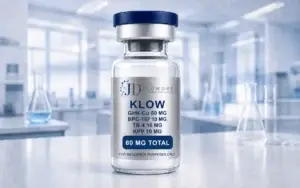
KLOW 80 mg Research Blend
KLOW 80 mg research blend labeled GHK-Cu 50 mg, BPC-157 10 mg, TB-500 10 mg, and KPV 10…
View Research Material