

PT-141 Research Hub · Evidence Overview
PT-141 (bremelanotide) research evidence: what has actually been studied?
A review of melanocortin-receptor-agonist research, including controlled human trials, safety signals, and the limits of extrapolating from an approved drug product.
Evidence at a glance
Overview
Bremelanotide is a melanocortin-receptor agonist developed from research on alpha-melanocyte-stimulating-hormone analogues. Human development included intranasal early studies and later subcutaneous studies. A specific finished drug product has FDA approval for a defined indication; that approval and evidence do not transfer to other materials bearing the name.
Research background
The RECONNECT program consisted of two phase 3 randomized, double-blind, placebo-controlled trials in premenopausal women with acquired, generalized hypoactive sexual desire disorder. Earlier dose-finding studies and ambulatory blood-pressure research helped characterize efficacy measures and transient cardiovascular effects.
Findings by research area
| Research area | What has been reported | What it does not establish |
|---|---|---|
| Phase 3 trials | Two randomized studies enrolled 1,267 participants and evaluated desire and distress endpoints. | Results in other populations or with another product. |
| Safety signals | Nausea, flushing, headache, and transient blood-pressure changes were reported. | General safety without contraindication and label context. |
| Early studies | Intranasal and subcutaneous protocols explored PK/PD and dose selection. | Equivalence across routes or formulations. |
Human data
The two RECONNECT trials randomized participants to 24 weeks of bremelanotide or placebo and reported statistically significant differences in prespecified desire and distress measures. Nausea, flushing, and headache were more common with active treatment. A separate randomized ambulatory-monitoring study detected small, transient increases in blood pressure with reductions in heart rate. These data are meaningful for the studied drug product and participants, but they do not validate an uncharacterized research preparation.
Animal data
Preclinical melanocortin research examined central pathways and behavioral endpoints. Such models helped define targets but do not reproduce human subjective outcomes or safety constraints.
In-vitro and analytical context
Receptor assays characterize melanocortin-receptor agonism and selectivity. They do not capture central nervous system distribution, cardiovascular responses, or patient-reported outcomes.
Research limitations
- Evidence applies to a defined finished drug product and protocol.
- Patient-reported endpoints require careful interpretation and validated instruments.
- Cardiovascular and tolerability findings remain important context.
- A research material cannot be presumed equivalent to the approved product.
Future research
Future research may refine receptor selectivity, identify predictors of response and adverse events, and expand comparative data, while maintaining exact product identity and appropriate regulatory context.
Primary references
- Kingsberg SA, et al. Bremelanotide for hypoactive sexual desire disorder: two randomized phase 3 trials. Obstet Gynecol. 2019. PMID:31599840.
- Clayton AH, et al. Bremelanotide dose-finding trial. Womens Health. 2016. doi:10.2217/whe-2016-0018.
- White WB, et al. Ambulatory blood-pressure assessment of bremelanotide. J Hypertens. 2017. doi:10.1097/HJH.0000000000001221.
Related Research Library articles
- How to read a Certificate of Analysis without overreading it
- HPLC basics: what a chromatogram can and cannot tell you
- Mass spectrometry basics: identity evidence, m/z, and method context
Article record
- Research question
- What does the published evidence on PT-141 show across human, animal, and laboratory research?
- Evidence cutoff
- July 15, 2026
- Article status
- Published educational research summary; not independently peer reviewed
- Author
- JD BioWorks Research Library
- Editorial review
- JD BioWorks Research Library
- Planned review cycle
- At least annually, or sooner if material evidence or regulatory information changes
This article summarizes published research for educational and laboratory-information purposes. It is not medical advice, does not provide instructions for personal use, and does not establish that any material is safe or effective for human or veterinary use.
Related Research Materials
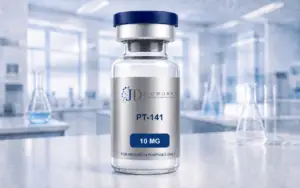
PT-141
PT-141 10 mg research material. Lot-specific analytical documentation is available below.
View Research Material