
TB-500 Research Hub · Evidence Overview
TB-500 research evidence: what has actually been studied?
A careful review of TB-500 that separates the marketed fragment name from research on full-length thymosin beta-4.
Evidence at a glance
Overview
TB-500 is commonly described in commercial and sports contexts as a thymosin beta-4-related fragment, while many cited publications studied full-length 43-amino-acid thymosin beta-4 (Tβ4). Sequence, molecular weight, secondary structure, stability, and actin binding can differ. Therefore, this article separates direct TB-500 evidence from parent-peptide evidence.
Research background
Human research has evaluated recombinant or synthetic full-length Tβ4 in healthy volunteers, venous ulcers, and ophthalmic applications. Those studies establish that full-length Tβ4 has entered clinical research; they do not establish safety or efficacy for an unspecified fragment marketed as TB-500.
Findings by research area
| Research area | What has been reported | What it does not establish |
|---|---|---|
| Exact TB-500 | Direct, well-characterized controlled human studies are not established in the primary record reviewed here. | Safety or efficacy in people. |
| Full-length Tβ4 | Randomized healthy-volunteer and phase 2 topical studies have been published. | Equivalent behavior of a fragment. |
| Preclinical Tβ4 | Cell and animal work examines migration, actin biology, angiogenesis, and tissue response. | Clinical outcomes for TB-500. |
Human data
A randomized single- and multiple-dose study evaluated intravenous full-length thymosin beta-4 in healthy volunteers, and a later first-in-human study evaluated recombinant human Tβ4. A phase 2 venous-ulcer study evaluated topical full-length Tβ4. These are not direct trials of a separately defined TB-500 fragment. No adequate controlled human evidence for the exact TB-500 material represented here was identified.
Animal data
Full-length Tβ4 preclinical studies examine cell migration, angiogenesis, inflammation, and tissue injury. Fragment activity depends on the retained sequence and conformation, so parent-peptide results cannot be assumed to apply.
In-vitro and analytical context
Actin binding and cell-migration assays are prominent in Tβ4 research. Any TB-500 experiment should publish exact sequence, purity, counterion, aggregation state, and a direct comparison with full-length Tβ4.
Research limitations
- Commercial naming does not consistently define the molecular sequence.
- Most cited human evidence concerns full-length Tβ4, not TB-500.
- Parent-peptide findings cannot be transferred automatically to a fragment.
- Human pharmacokinetics, safety, and efficacy for exact TB-500 remain unresolved.
Future research
The priority is an unambiguous molecular definition followed by validated identity and purity testing, direct head-to-head pharmacology with full-length Tβ4, toxicology, pharmacokinetics, and only then controlled human research.
Lot-specific analytical documentation
JD BioWorks publishes product and lot records separately from this literature review. For the currently documented TB-500 10 mg research material, review the public product specifications and the matching Certificate of Analysis record. The laboratory report describes the tested lot only and does not establish safety, efficacy, sterility, or suitability for human or veterinary use.
Primary references
- Ruff D, et al. Randomized single- and multiple-dose study of intravenous thymosin beta4 in healthy volunteers. Ann N Y Acad Sci. 2010. doi:10.1111/j.1749-6632.2010.05474.x.
- Wang X, et al. First-in-human study of recombinant human thymosin beta4. J Cell Mol Med. 2021. doi:10.1111/jcmm.16693.
- Guarnera G, et al. The effect of thymosin treatment of venous ulcers. Ann N Y Acad Sci. 2010. doi:10.1111/j.1749-6632.2010.05490.x.
Related Research Library articles
- How to read a Certificate of Analysis without overreading it
- HPLC basics: what a chromatogram can and cannot tell you
- Mass spectrometry basics: identity evidence, m/z, and method context
Article record
- Research question
- What does the published evidence on TB-500 show across human, animal, and laboratory research?
- Evidence cutoff
- July 15, 2026
- Article status
- Published educational research summary; not independently peer reviewed
- Author
- JD BioWorks Research Library
- Editorial review
- JD BioWorks Research Library
- Planned review cycle
- At least annually, or sooner if material evidence or regulatory information changes
This article summarizes published research for educational and laboratory-information purposes. It is not medical advice, does not provide instructions for personal use, and does not establish that any material is safe or effective for human or veterinary use.
Related Research Materials
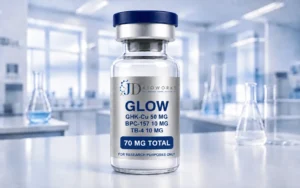
GLOW 70 mg Research Blend
GLOW 70 mg research blend. Labeled formulation: GHK-Cu 50 mg, BPC-157 10 mg, and TB-4 10 mg. Lot-specific…
View Research Material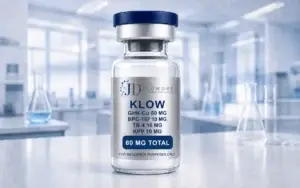
KLOW 80 mg Research Blend
KLOW 80 mg research blend labeled GHK-Cu 50 mg, BPC-157 10 mg, TB-500 10 mg, and KPV 10…
View Research Material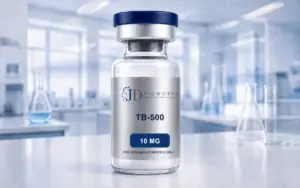
TB-500
TB-500 10 mg research material with lot-specific ILS Laboratories COA, HPLC purity and identity documentation. For qualified laboratory…
View Research Material