

Tesamorelin Research Hub · Evidence Overview
Tesamorelin research evidence: what has actually been studied?
A review of tesamorelin clinical research, metabolic findings, safety context, and the difference between an approved drug product and research material.
Evidence at a glance
Overview
Tesamorelin is a stabilized analogue of growth-hormone-releasing hormone. It stimulates pituitary GH release and downstream IGF-I within an intact endocrine axis. A specific finished drug product has FDA approval for reduction of excess abdominal fat in adults with HIV and lipodystrophy; that status does not transfer to another material bearing the molecule name.
Research background
Clinical development included large randomized trials in people with HIV-associated abdominal fat accumulation. Later studies examined liver-fat and metabolic questions in selected populations. Research also evaluated glucose-related safety because GH-axis stimulation can affect insulin sensitivity.
Findings by research area
| Research area | What has been reported | What it does not establish |
|---|---|---|
| HIV lipodystrophy trials | Two phase 3 programs enrolled hundreds of participants and measured visceral-fat outcomes. | Benefit in unrelated populations. |
| Liver-fat research | A randomized multicenter trial evaluated hepatic fat in people with HIV and fatty liver disease. | A general liver-disease treatment conclusion. |
| Metabolic safety | A randomized study in type 2 diabetes examined insulin sensitivity and glycemic control. | Absence of risk in every population. |
Human data
A pooled phase 3 analysis included 806 antiretroviral-treated participants with excess abdominal fat. A separate 12-month randomized trial and extension examined visceral-fat outcomes and durability. In a 61-participant study of people with HIV and nonalcoholic fatty liver disease, tesamorelin produced a greater reduction in hepatic fat fraction than placebo. A 53-participant type 2 diabetes study focused on insulin sensitivity and glycemic control. Each result belongs to its population and protocol.
Animal data
Preclinical studies supported GHRH-receptor activity and analogue stability, but the established human trial record for the defined drug product is more informative than animal models for clinical interpretation.
In-vitro and analytical context
Receptor and peptide-stability assays can characterize activity and degradation. They cannot replicate pulsatile pituitary output, hepatic IGF-I production, glucose regulation, or adverse-event patterns.
Research limitations
- Evidence is tied to defined pharmaceutical formulations and selected populations.
- GH-axis effects require ongoing safety context, including glucose and IGF-I measures.
- Body-composition endpoints do not automatically establish long-term health outcomes.
- A research material cannot be presumed equivalent to an approved product.
Future research
Useful research includes long-term outcomes, metabolic subgroups, comparative studies, predictors of response, and rigorous analytical bridging for any new formulation.
Primary references
- Falutz J, et al. Effects of tesamorelin in HIV-infected patients with abdominal fat accumulation. J Acquir Immune Defic Syndr. 2010. PMID:20101189.
- Clemmons DR, et al. Safety and metabolic effects of tesamorelin in type 2 diabetes. PLoS One. 2017. doi:10.1371/journal.pone.0179538.
- Stanley TL, et al. Effects of tesamorelin on fatty liver disease in HIV. Lancet HIV. 2019. PMID:31611038.
Related Research Library articles
- How to read a Certificate of Analysis without overreading it
- HPLC basics: what a chromatogram can and cannot tell you
- Mass spectrometry basics: identity evidence, m/z, and method context
Article record
- Research question
- What does the published evidence on Tesamorelin show across human, animal, and laboratory research?
- Evidence cutoff
- July 15, 2026
- Article status
- Published educational research summary; not independently peer reviewed
- Author
- JD BioWorks Research Library
- Editorial review
- JD BioWorks Research Library
- Planned review cycle
- At least annually, or sooner if material evidence or regulatory information changes
This article summarizes published research for educational and laboratory-information purposes. It is not medical advice, does not provide instructions for personal use, and does not establish that any material is safe or effective for human or veterinary use.
Related Research Materials
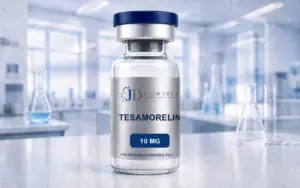
Tesamorelin
Tesamorelin 10 mg research material. Lot-specific analytical documentation is available below.
View Research Material