

Selank Research Hub · Evidence Overview
Selank research evidence: what has actually been studied?
A source-based review of the published human and preclinical literature, with study design, limitations, and verified references presented in context.
Evidence at a glance
Overview
Selank is a seven-amino-acid peptide described by the sequence Thr-Lys-Pro-Arg-Pro-Gly-Pro (TKPRPGP). Public chemical records list CAS Registry Number 129954-34-3 and molecular formula C33H57N11O9. Researchers should confirm the identity, form, purity method, and lot-specific analytical record for the material actually evaluated.
The literature most often describes Selank as a synthetic analogue of tuftsin. Published investigations span behavioral models, gene-expression work related to neurotransmission, cytokine measurements under experimental stress, and a limited clinical literature. These are distinct evidence types and should not be treated as interchangeable.
Evidence map
| Research area | What was studied | Key limitation |
|---|---|---|
| Human comparative study | A 2008 Russian-language report compared Selank with medazepam in 62 participants assessed with psychometric measures. | Limited accessible reporting, a small sample, and insufficient evidence for broad conclusions about efficacy or safety. |
| GABA-related gene expression | A rat frontal-cortex study measured expression changes across 84 neurotransmission-related genes after Selank or GABA exposure. | Short-term molecular observations in rats do not establish a human mechanism or clinical outcome. |
| Learning and memory models | Rat active-avoidance experiments compared repeated Selank exposure with piracetam. | Behavioral performance in a selected animal model is not evidence of human benefit. |
| Stress and cytokines | An animal study measured cytokines under a social-stress paradigm. | Model-specific biomarker changes do not establish treatment effects in people. |
| BDNF and ethanol model | A rat study examined object recognition and BDNF content after chronic ethanol exposure. | Highly specific disease-model conditions limit generalization. |
What the clinical literature can—and cannot—show
A PubMed-indexed 2008 comparative study reported on 62 participants with generalized anxiety disorder or neurasthenia, comparing Selank with medazepam. The article is in Russian, and the indexed abstract reports psychometric and serum enkephalin measurements. Although PubMed classifies it as a randomized controlled trial, the available record does not provide the depth of methods, replication, or contemporary regulatory evidence needed to establish broad clinical safety or effectiveness.
The appropriate interpretation is therefore narrow: a human comparison has been reported, but the evidence base remains limited. It should not be extrapolated into dosing, administration, therapeutic, or consumer-use guidance.
Molecular and animal research
A 2016 rat study examined 84 genes involved in neurotransmission and reported time-dependent expression changes after Selank or GABA exposure. The authors interpreted the pattern as compatible with a possible relationship to GABAergic signaling. This is a mechanistic hypothesis from an animal gene-expression experiment—not confirmation of a clinical mechanism.
Other work has used active-avoidance learning paradigms, chronic-ethanol models, and experimental social stress. These studies can help define measurable laboratory endpoints and future experiments, but differences in species, route, dose, model, and assay make direct translation inappropriate.
Analytical and documentation considerations
For laboratory procurement, the published name alone is not enough to establish material identity. A defensible evaluation should connect the vial label and lot number to a lot-specific Certificate of Analysis and review the analytical methods used for identity and purity. HPLC may describe separation and relative purity, while mass-spectrometric evidence can address molecular identity; neither should be assumed to answer every analytical question by itself.
- Confirm the stated sequence, formula, and molecular mass against the supplied form.
- Match the product lot to its specific analytical report.
- Review method names, chromatograms, spectra, acceptance criteria, and report dates.
- Document storage, handling, and chain-of-custody conditions used by the laboratory.
Major limitations in the evidence base
- Much of the literature is preclinical and comes from a relatively concentrated group of investigators.
- Several human and early studies have limited English-language methodological detail.
- Independent replication, pharmacokinetic characterization, and contemporary controlled human evidence are limited.
- Experimental outcomes cannot be used to infer safety, efficacy, or appropriate administration in humans or animals.
Verified sources
- Zozulia AA, et al. Efficacy and possible mechanisms of action of a new peptide anxiolytic Selank in generalized anxiety disorders and neurasthenia. Zh Nevrol Psikhiatr Im S S Korsakova. 2008;108(4):38-48. PubMed PMID 18454096.
- Volkova AA, et al. Selank administration affects the expression of some genes involved in GABAergic neurotransmission. Front Pharmacol. 2016;7:31. PubMed PMID 26924987.
- Kozlovskii II, Danchev ND. The optimizing action of the synthetic peptide Selank on a conditioned active avoidance reflex in rats. Neurosci Behav Physiol. 2003;33(7):639-643. PubMed PMID 14552529.
- Kolik LG, et al. Selank, peptide analogue of tuftsin, protects against ethanol-induced memory impairment by regulating BDNF content in rats. Bull Exp Biol Med. 2019;167(5):641-644. PubMed PMID 31625062.
- Yasenyavskaya AL, et al. The influence of Selank on the level of cytokines under conditions of social stress. Curr Rev Clin Exp Pharmacol. 2021;16(2):162-167. PubMed PMID 32621722.
Research record
- Compound
- Selank
- Sequence
- TKPRPGP
- CAS
- 129954-34-3
- Evidence reviewed
- Human comparative study, animal behavioral models, gene-expression and cytokine studies
- Review date
- July 27, 2026
This article is an educational summary for qualified laboratory and analytical research. It is not medical advice and does not provide instructions for human or veterinary use. JD BioWorks materials are not for injection, ingestion, administration, application, or other use in humans or animals.
Related Research Materials
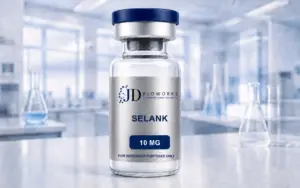
Selank
Selank 10 mg research material. Lot-specific analytical documentation is available below.
View Research Material