
Tirzepatide Research Hub · Evidence Overview
Tirzepatide research evidence: what has actually been studied?
A structured review of dual GIP/GLP-1 receptor agonism, major randomized human trials, safety findings, and product-equivalence limits.
Evidence at a glance
Overview
Tirzepatide is a single peptide engineered to activate glucose-dependent insulinotropic polypeptide and glucagon-like peptide-1 receptors. Its evidence base includes large randomized phase 3 programs in type 2 diabetes and chronic weight-management populations. The molecular name should not obscure product quality: identity, potency, impurities, aggregation, sterility where applicable, and formulation are separate analytical questions.
Research background
SURPASS trials compared tirzepatide with placebo and active treatments across several type 2 diabetes settings. SURMOUNT trials examined chronic weight management. These studies provide robust evidence for sponsor-manufactured finished drug products under controlled protocols. They do not validate unrelated research preparations or support administration guidance on this site.
Findings by research area
| Research area | What has been reported | What it does not establish |
|---|---|---|
| SURPASS-1 | A double-blind phase 3 trial randomized 478 participants to three tirzepatide doses or placebo. | Equivalence to another material or outcomes beyond the protocol. |
| SURPASS-2/4 | Large active-controlled trials compared tirzepatide with semaglutide or insulin glargine. | A simple class-wide conclusion without comparator and population context. |
| Safety | Gastrointestinal events were common; safety interpretation depends on label, dose escalation, comorbidities, and follow-up. | Universal safety or suitability. |
Human data
SURPASS-1 reported greater reductions in glycated hemoglobin and body weight with all three tirzepatide groups than placebo over 40 weeks. SURPASS-2 randomized 1,879 participants and compared tirzepatide with semaglutide 1 mg. SURPASS-4 enrolled 2,002 people with type 2 diabetes and elevated cardiovascular risk and compared tirzepatide with insulin glargine. These trials are large and controlled, but they remain evidence for the studied pharmaceutical product, populations, and endpoints.
Animal data
Preclinical studies characterized dual-receptor agonism, glucose control, food intake, and body composition. Species differences and engineered receptor balance mean clinical results should not be inferred from animal outcomes alone.
In-vitro and analytical context
Cell assays quantify potency and signaling at GIP and GLP-1 receptors. They are necessary for molecule characterization but cannot determine clinical exposure, tolerability, or outcome benefit.
Research limitations
- Evidence applies to defined approved drug products and controlled protocols.
- Comparator dose, trial population, estimand, and follow-up affect interpretation.
- Long-term outcomes require their own dedicated studies.
- Independent research material cannot be presumed pharmaceutically equivalent.
Future research
Ongoing priorities include long-term cardiovascular and renal outcomes, comparative effectiveness, diverse populations, pharmacovigilance, and rigorous analytical methods that distinguish identity from pharmaceutical equivalence.
Primary references
- Rosenstock J, et al. Tirzepatide monotherapy versus placebo in type 2 diabetes (SURPASS-1). Lancet. 2021. doi:10.1016/S0140-6736(21)01324-6.
- Frías JP, et al. Tirzepatide versus semaglutide once weekly in type 2 diabetes. N Engl J Med. 2021. PMID:34170647.
- Del Prato S, et al. Tirzepatide versus insulin glargine (SURPASS-4). Lancet. 2021. doi:10.1016/S0140-6736(21)02188-7.
Related Research Library articles
- How to read a Certificate of Analysis without overreading it
- HPLC basics: what a chromatogram can and cannot tell you
- Mass spectrometry basics: identity evidence, m/z, and method context
Article record
- Research question
- What does the published evidence on Tirzepatide show across human, animal, and laboratory research?
- Evidence cutoff
- July 15, 2026
- Article status
- Published educational research summary; not independently peer reviewed
- Author
- JD BioWorks Research Library
- Editorial review
- JD BioWorks Research Library
- Planned review cycle
- At least annually, or sooner if material evidence or regulatory information changes
This article summarizes published research for educational and laboratory-information purposes. It is not medical advice, does not provide instructions for personal use, and does not establish that any material is safe or effective for human or veterinary use.
Terminology note
Tirzepatide is a dual GIP and GLP-1 receptor agonist. It is not GLP-2, which is a separate proglucagon-derived peptide. Read the GLP-2, GLP-3, tirzepatide, and retatrutide terminology guide.
Related Research Materials
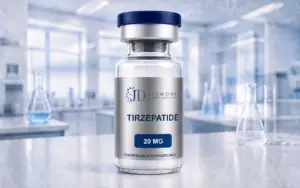
Tirzepatide
Available in 20 mg, 40 mg, and 60 mg quantities. Lot-specific analytical documentation will be associated with each…
View Research Material