
Can AI Predict Peptide Solubility? What a Benchmark Really Tests
AI can predict peptide solubility within a defined evaluation, but a benchmark score is not a guarantee about a different peptide, solvent or laboratory. The useful question is what the model was tested on—and whether that test resembles the decision someone wants to make.
The PeptSol benchmark, version 2, provides a timely example. Revised on November 4, 2026 and accepted at the AI for Drug Discovery workshop at NeurIPS 2026, this author-posted preprint concerns protected peptide intermediates used in manufacturing. It is not a clinical study or finished-vial handling guide.
What does PeptSol actually test?
The researchers curated 1,388 measurements covering 84 parent sequences and 101 protected structures; 92.5% came from one historical programme. They compared seven frozen molecular encoders with simpler baselines. Model rankings depended on the task and split, and no foundation model consistently beat the chemical-fingerprint-plus-descriptor baseline. These are bounded retrospective comparisons, not a universal ranking of AI tools. Read the original methods, results and limitations.
Protection chemistry and the manufacturing task are central to that scope. Do not silently substitute “any research peptide” for “the protected structures evaluated here.”
Read the evaluation before the headline score
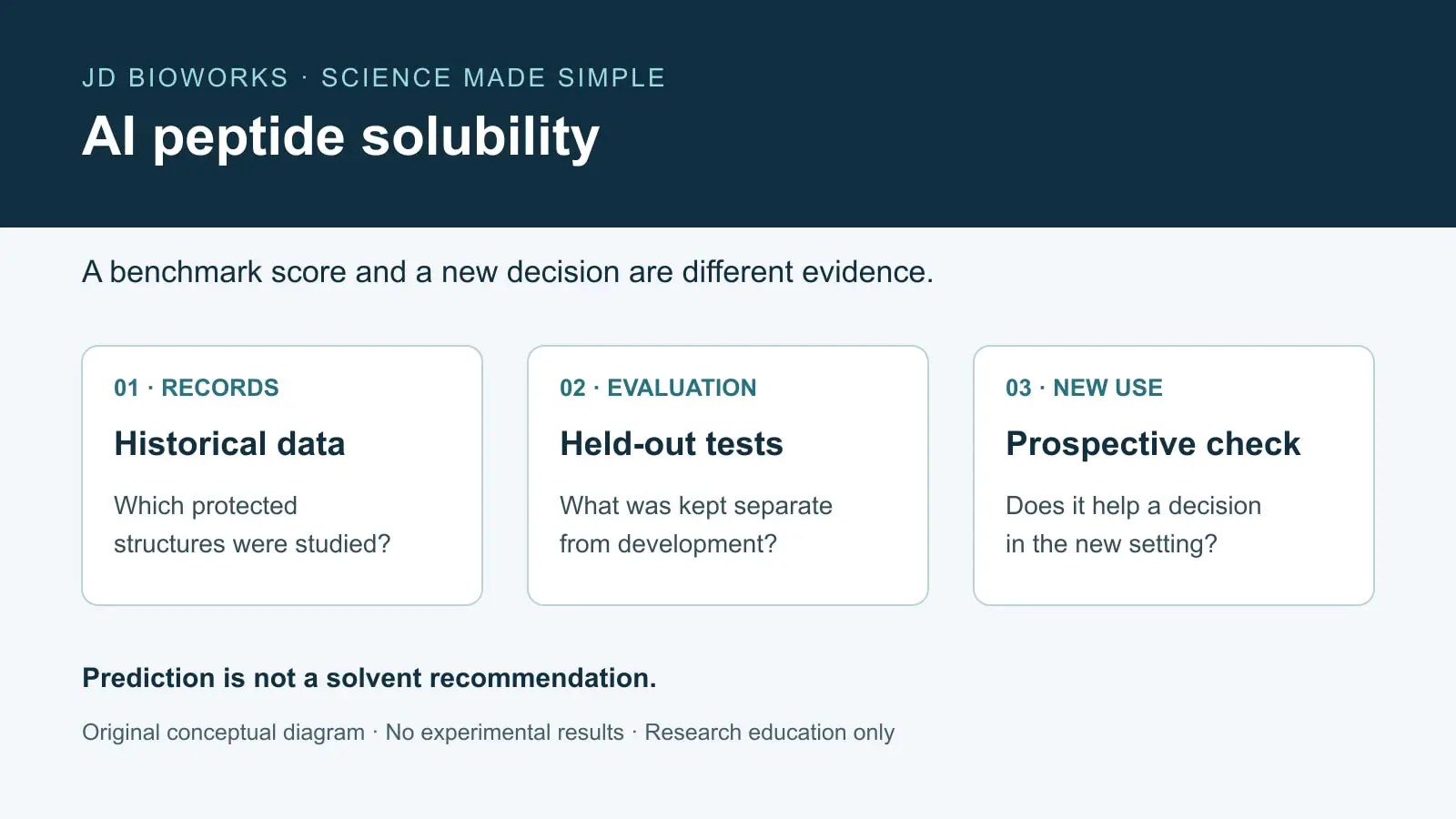
A practical reading record can separate three questions. The table below is our explanatory checklist, not a reproduction of the study’s experiments.
| Record | Question | Avoid assuming |
|---|---|---|
| Material and task | Which structures and solubility labels were evaluated? | That a manufacturing-intermediate result applies to a finished material. |
| Held-out evaluation | What was kept separate from model development? | That every reported score tests a genuinely new setting. |
| New decisions | Was the proposed use evaluated prospectively? | That retrospective prediction already demonstrated practical benefit. |
A dataset split describes how records were separated for an evaluation. Read its actual definition rather than treating the word “held-out” as a complete explanation. PeptSol’s authors explicitly distinguish benchmark progress from prospective evidence that a model improves manufacturing decisions.
Worked example: two fictional evaluation summaries
The summaries below are invented teaching examples. They are not PeptSol results, laboratory records or claims about JD BioWorks materials.
Summary A: “Our model predicts peptide solubility accurately.” It supplies no material definition, task, split, baseline or new-setting evaluation. The statement is too broad to assess from that sentence alone.
Summary B: “For this named dataset version, this specified task and this documented held-out split, we compared the model with the listed baseline.” That is a more checkable claim. It still does not establish performance for an untested material or prove that using the model changes a real decision.
The improvement is traceability: a reader can find the evaluation and examine its boundaries. More precise reporting is not the same thing as a stronger experimental result.
What should an AI-assisted report make clear?
- The model and dataset version being discussed.
- The material family and exact prediction question.
- The evaluation design, comparison and limitations.
- Which statements come from measurements, predictions or a separate prospective test.
These are reading prompts, not a universal laboratory acceptance standard. For a different AI task, see how AI can interpret a peptide’s MS/MS spectrum. A spectrum-based sequence inference and a solubility prediction answer different questions.
What this does not establish
This benchmark does not validate a JD BioWorks lot, prescribe a solvent or storage condition, or establish purity, identity, amount, sterility or suitability for administration. Use the documentation checklist to review material-specific records, and the TFA and peptide-content guide for a separate discussion of material composition.
For qualified laboratory, analytical and educational research evaluation only. Not medical guidance or instructions for human or veterinary use. JD BioWorks supplies research materials; citation of research is not a claim that its products were tested in that study.