
How Can AI Read a Peptide’s MS/MS Spectrum?
AI can propose an amino-acid sequence from a peptide’s tandem mass spectrum by learning relationships between measured ion signals and known sequences. That is an interpretation of experimental data—not a substitute for collecting the data or documenting the sample. A predicted sequence is not, by itself, a lot-specific certificate of analysis.
A new MassNet study makes this distinction timely. The useful question is not whether an analysis uses AI, but what was measured, what the software inferred, and how the result was checked.
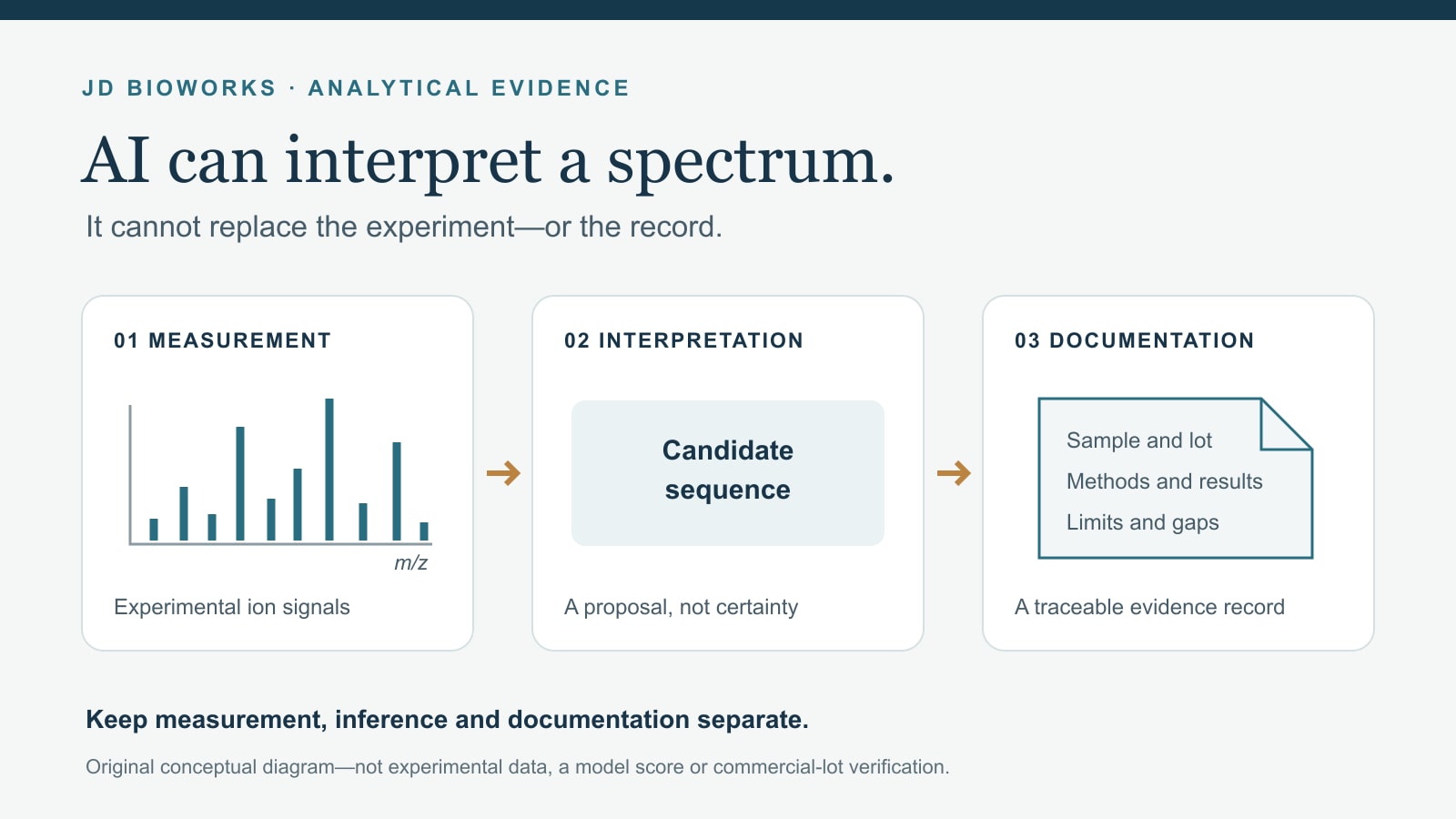
What does the instrument measure—and what does the model infer?
Mass spectrometry characterizes ions. Its familiar horizontal-axis notation, m/z, relates an ion’s mass to its charge number; it is not simply a neutral molecule’s weight. Tandem mass spectrometry, or MS/MS, adds information about selected ions and their products. These distinctions are described in Penn State’s mass-spectrometry definitions, based on IUPAC terminology.
In de novo peptide sequencing, software uses the spectrum to infer a candidate sequence rather than only looking for a match in a sequence database. “De novo” does not mean the prediction is certain or that a model has never learned from previously identified peptides. The MassNet paper illustrates that distinction.
Keep three layers separate when reading a result:
| Layer | Question to ask |
|---|---|
| Measurement | What sample and ion signals were actually analyzed? |
| Interpretation | What sequence or identity assignment does the software propose? |
| Documentation | How does the laboratory connect its conclusion and limitations to this sample and lot? |
This is a document-reading framework, not a claim that every laboratory must use the same workflow. Our sequence, molecular mass and identity guide explains the underlying terminology.
What did the new MassNet study add?
Published in Nature Methods on October 14, 2026, the study describes a resource built from approximately 1.5 billion acquired tandem-MS spectra across 35 species. Its model-ready identified records are a filtered subset—not 1.5 billion independently confirmed peptide identities. The researchers also developed a sequencing model called XuanjiNovo. This is proteomics research, not a study validating JD BioWorks materials. Read the original paper.
Why a strong benchmark is not a universal accuracy guarantee
The model was not uniformly best across datasets. The authors report lower peptide recall than existing methods for most species in one nine-species benchmark before additional fine-tuning. Their Discussion also identifies selection bias from retaining confidently identified spectra, differences among instruments and annotation pipelines, and limited modification coverage. Preliminary peptide-spectrum-match rescoring produced fewer identifications than established workflows. MassNet, Results and Discussion.
For a reader evaluating an AI-assisted report, the practical follow-up is specific: ask whether the evaluation resembles the material, instrument and analytical question at hand. A general benchmark should not be silently relabeled as a validation result for a different sample. Ask what any reported confidence score means; do not assume it is a calibrated probability that the sequence is correct.
Does an AI sequence prediction prove purity or the amount in a vial?
Do not turn one kind of result into another. A peptide-sequence assignment, a chromatographic purity result and an amount measurement answer different questions. A published set of recommendations for peptide standards used in mass-spectrometry assays discusses identity characterization, purity and quantity separately. Its recommendations concern analytical standards; they are not a universal supplier certification.
Our HPLC-versus-LC-MS guide covers those distinctions. Neither an instrument name nor an AI label fills in a missing measurement.
Five useful questions about an AI-assisted identity result
- Which material was analyzed? Match the sample identifier, declared sequence, relevant chemical form and lot.
- Which data support the assignment? Ask whether the report includes MS/MS evidence, rather than assuming every LC-MS report contains a sequence assessment.
- Which software produced the result? Request the model or method version and an explanation of any reported score.
- What was covered by the evaluation? Ask about instrument context, relevant modifications and unresolved assignments.
- What remains undocumented? Keep identity, purity, quantity and other testing questions separate. Record missing evidence without inventing a pass or failure.
Use the research peptide documentation checklist to keep the report, lot connection and open questions together. For a JD BioWorks research lot, request its corresponding original analytical record rather than treating this article as product verification.
The takeaway: AI can help interpret spectra. The responsible conclusion still depends on the actual experiment, the interpretation’s limits and a traceable record.
For qualified laboratory and analytical research education only. Not for human or veterinary use. This article does not provide medical advice, dosing, administration or treatment guidance, and it does not establish clinical suitability or verify any commercial lot.