
What Are Macrocyclic Peptides—and What Does Crosslinking Change?
A macrocyclic peptide contains a large molecular ring. Crosslinking can create that ring by joining two sites within a peptide with a chemical bond or bridge. The connection changes which shapes the molecule can adopt. It does not, by itself, show that the peptide works better, enters cells, or is suitable for use in people. Two recent synthesis papers illustrate why the exact bridge—and the evidence behind it—matter. October 13 synthesis paper; amine-crosslinking study.
What makes a peptide macrocyclic?
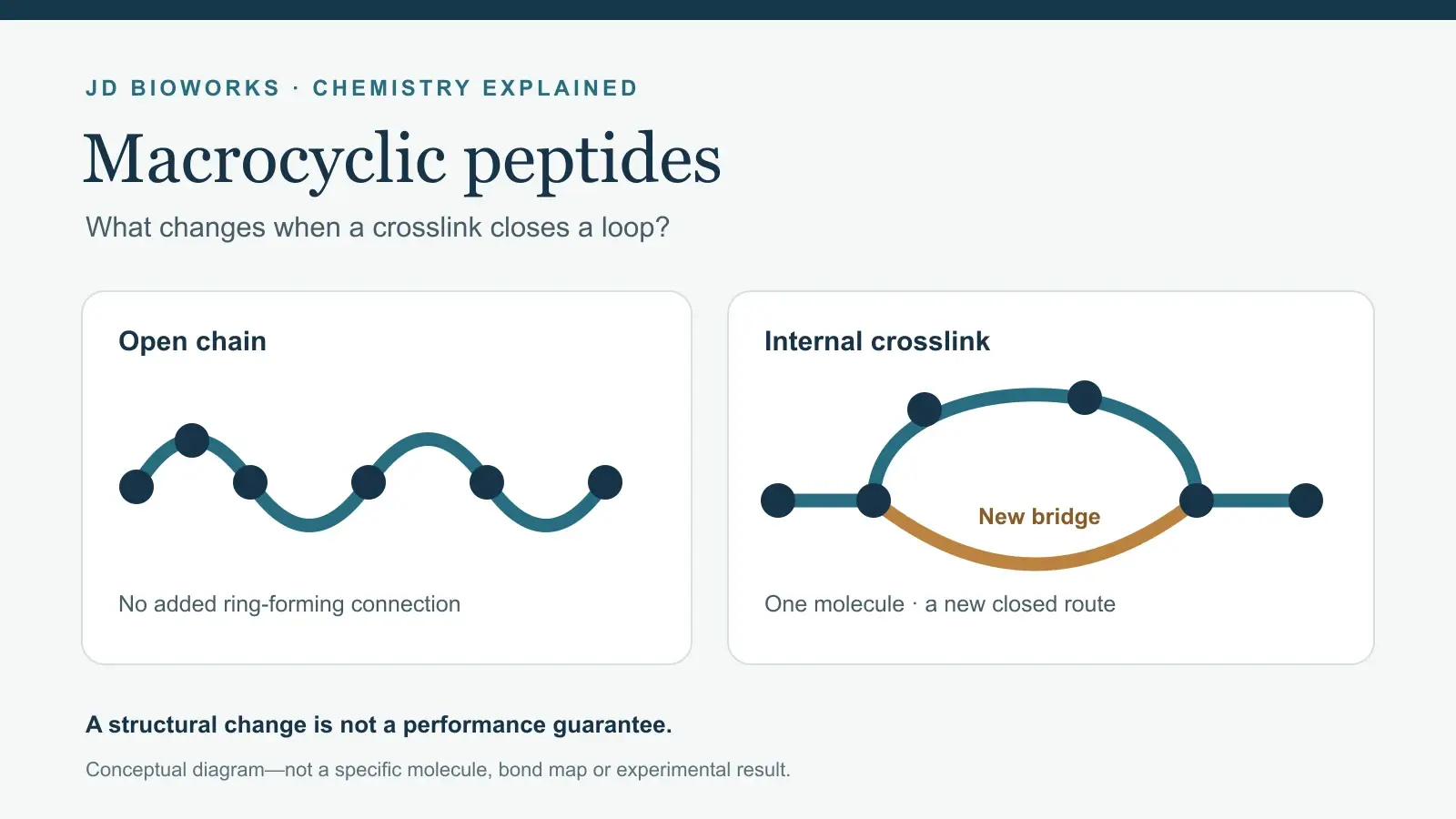
A peptide is a chain of amino-acid residues. A macrocycle adds a closed route through part or all of that molecular structure. The connection can join the chain’s ends, connect side chains, or link an end to a side chain. These are different architectures, not interchangeable names for one substance. The introduction and experiments in Liu and colleagues’ study describe several approaches and demonstrate one particular type.
Think of a flexible cord with a clasp between two points. Closing the clasp limits some movements, but the cord does not necessarily become a rigid circle. Likewise, a peptide’s ring size, sequence, bridge chemistry and attachment positions help determine its behavior. The illustration accompanying this article is a conceptual comparison, not a chemical structure or experimental result.
Is crosslinking the same as mixing peptides?
No. In the intramolecular crosslinking discussed here, a new chemical connection forms within one molecule. An intermolecular crosslink instead connects different molecules. Simply combining two peptides in a vial does not establish either kind of covalent structure.
This is why “blend,” “crosslinked,” “cyclic” and “macrocyclic” should not be treated as synonyms. To understand a reported material, identify the actual structure and the evidence used to establish it—not just the descriptive label.
What changed in the October 13 research?
Huang and colleagues reported a route to tryptophan-crosslinked macrocyclic peptides in Nature Synthesis. Their abstract describes rhodium-catalysed ring formation using a removable directing group. They demonstrate the approach with complex peptide structures, including pharmacophores of micitide 982 and tryglysin. This is a synthesis advance: another way for chemists to access particular molecular architectures. Original paper, published October 13, 2026.
That result is not evidence that an unrelated commercial peptide has acquired those structures or properties. Our coverage of this paper is limited to its accessible abstract and publication information; we did not review the subscription-only full methods.
A different study shows why the bridge matters
A separate Nature Communications paper, published September 2, reports urea and thiourea bridges between peptide amines, including lysine side chains. Its experiments examine selected structures and properties rather than establishing one universal crosslinking solution. The authors also describe limits: certain cyclizations were unsuccessful, and cysteine required protection in their method. Original open-access study.
The two papers address different chemical connections. A result for a lysine-linked example cannot simply be assigned to a tryptophan-crosslinked molecule—or to every peptide called “cyclic.”
Does making a ring automatically improve a peptide?
No. Ring formation is a structural change, not a universal performance guarantee. Researchers can test whether a particular modification changes degradation, molecular recognition or other properties. Each question needs its own comparison. The amine-crosslinking paper, for example, evaluates selected analogues in laboratory assays; those findings have a defined experimental scope.
Three distinctions make headlines easier to interpret:
- A synthesis result shows that a structure was made and characterized under the reported conditions.
- A laboratory property result concerns the tested molecule, assay, comparator and conditions.
- A result in people would require appropriate human evidence. A cell experiment or a more stable sample in an assay cannot substitute for it.
It is therefore inaccurate to turn “new way to make a ring” into “new proven treatment.” This article makes no clinical claim for either method or for JD BioWorks materials.
What should a researcher look for in the evidence?
Use a structure-first reading checklist:
- Identify the molecule. Look for the sequence, ring-forming sites and bridge chemistry, not only a product or scaffold name.
- Separate synthesis from performance. Ask what was actually measured and which comparator was used.
- Check characterization. Review the analytical evidence supporting the proposed structure. In the amine-crosslinking study, the researchers provide multiple forms of characterization; a single purity percentage is not that full evidence package.
- Read the limits. Failed examples, assay conditions and exceptions help define where a method applies.
- Keep the evidence level visible. Computational models, laboratory assays and human studies answer different questions.
For help interpreting analytical records, see our HPLC versus LC-MS comparison and HPLC chromatogram guide. These explain what particular measurements can—and cannot—establish.
The useful takeaway
Macrocyclic-peptide research is about precise molecular design. A crosslink can create a ring and change the accessible shapes, but the bridge and the measurements determine what can responsibly be concluded. The new papers expand chemistry tools; they do not validate a whole product category.
Continue with the JD BioWorks Research Library for source-linked explanations. For a different chemistry question, our tetrapeptide catalyst article examines what it means for a short peptide to help a chemical reaction.
Educational chemistry coverage, checked October 15, 2026. Not a synthesis protocol or medical advice. JD BioWorks materials are for qualified laboratory research, not human or veterinary use. This article does not establish the identity, performance, safety or clinical suitability of any commercial material.