
What an MIC Result Proves About Antimicrobial Peptides
An antimicrobial peptide MIC result tells you the concentration that met the study's stated growth-inhibition endpoint for a particular organism under particular test conditions. MIC stands for minimum inhibitory concentration. In conventional bacterial tests, the endpoint is no visible growth—but some modified peptide methods use a different definition. Check the method before comparing the numbers. Original MIC methods paper, University of British Columbia peptide method.
That result is not, by itself, proof that the peptide killed the bacteria, that it acts against every microorganism, or that it is safe and effective in people. The useful question is not simply “Did it work?” It is “What was tested, how was activity defined, and how far does the result reach?”
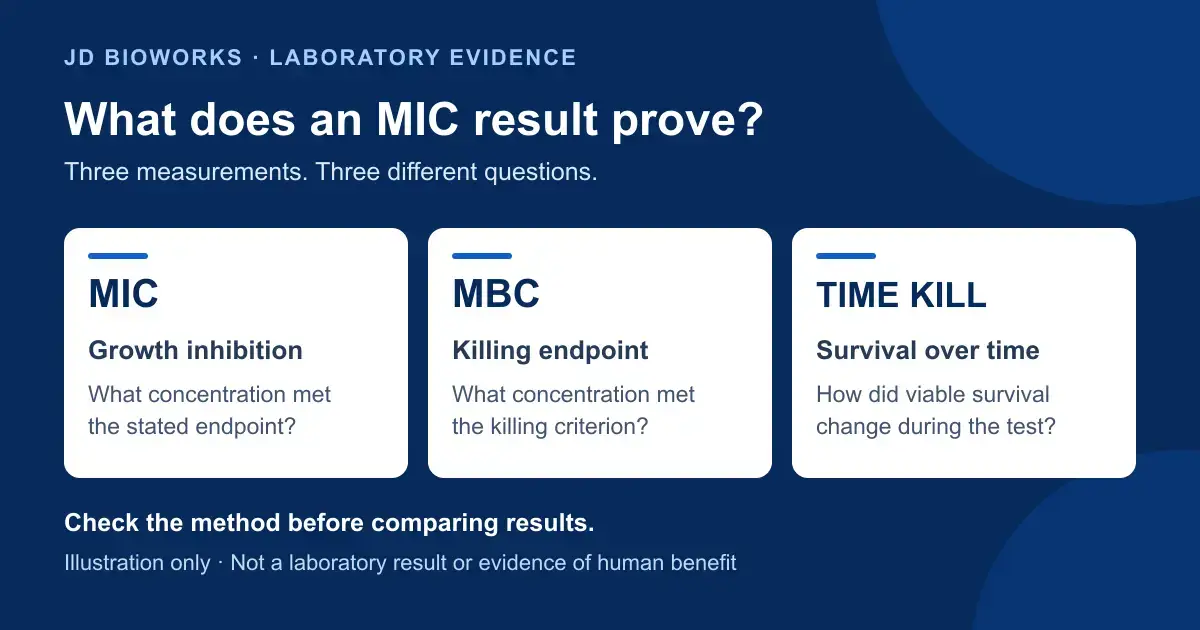
Start with the endpoint, not the headline
An MIC value is a result from a defined growth assay, not a universal score for a molecule. The November 2024 methods paper explains that MIC interpretation depends on the organism, assay conditions and method. Original methods paper.
The distinction is particularly important for antimicrobial peptides. The University of British Columbia's modified method for cationic antimicrobial peptides uses an endpoint of more than 50% growth reduction. That differs from the conventional no-visible-growth definition. Its method also discusses peptide binding to laboratory plastics. UBC method.
Neither the word “MIC” nor a small-looking number resolves those differences. A reader needs the endpoint and method reference before deciding whether two reports answer the same question.
This guide focuses on bacterial growth and killing assays. A bacterial result does not establish activity against viruses, fungi or every other organism.
MIC and MBC answer different questions
Growth inhibition and killing are related, but they are not interchangeable measurements.
On narrow screens, scroll the table horizontally to see all columns.
| Result | Question it addresses | What remains unresolved |
|---|---|---|
| MIC | What concentration met the stated growth-inhibition endpoint? | Whether the organisms were killed, and how quickly |
| MBC, or minimum bactericidal concentration | What concentration met the method's bactericidal endpoint, assessed through viable survival? | The full time course of killing and performance in other settings |
| Time-kill analysis | How did viable survival change over the tested time period? | Whether the finding transfers to a different organism, material or biological setting |
An original 2022 study of magainin 2 and Escherichia coli examined growth inhibition, bactericidal activity and time-dependent effects separately. Its single-cell analysis also illustrates why a population-level endpoint does not describe every individual cell's behavior. Those findings concern that peptide and experimental system; they are not a result for every antimicrobial peptide. Hossain and colleagues, Microbiology Spectrum.
If a report supplies only MIC, do not silently upgrade its conclusion from “inhibited growth under this assay” to “killed the bacteria.” If killing is the research question, look for the separate measurement that addresses it.
Why two MIC values may not be comparable
Before comparing reports, establish whether they used the same endpoint, organism and relevant assay conditions. Check the units and the identity of the tested peptide as well. A report that leaves these details unclear gives you less basis for comparison, even if its headline result appears impressive. The original methods paper and UBC's peptide-specific method both show why the test setup belongs alongside the result. MIC methods paper, UBC method.
Consider two fictional records, not JD BioWorks test results:
- Record A states the organism, peptide identity, method and a no-visible-growth endpoint.
- Record B says “MIC confirmed,” but supplies no endpoint or method reference.
Record B does not establish that the comparison is like-for-like. The missing information should be recorded as a gap, not filled in from Record A. Even two complete reports may use different endpoints and require a qualified interpretation rather than a simple ranking.
For the same reason, a lower MIC is not automatically evidence of a better medicine. A growth assay has not answered the separate questions about safety, exposure or clinical benefit.
A computational prediction is not a measured MIC
Recent antimicrobial peptide research often combines computational design with experiments. Keep the evidence stages distinct.
In a July 7, 2026 Nature Communications study, researchers used a diffusion-model approach called ARCADIAMP to generate candidates and then performed experimental activity testing. They also reported separate assessments involving hemolysis, cell toxicity, serum stability and a mouse wound model. These were different questions, not interchangeable confirmations of one claim. Original ARCADIAMP paper.
A model's predicted activity is not a lab-measured MIC. A human red-blood-cell assay is not a human clinical trial. A mouse-model finding is not established patient benefit. The study is useful precisely because its separate tests can be examined separately; none should be substituted for the others.
Nor should its findings be transferred to a catalog material merely because both are called peptides. The tested candidate, its characterization and the experimental setting have to match the claim being made. This article does not assert antimicrobial performance for any JD BioWorks product.
Where a COA fits
An analytical certificate of analysis and a functional antimicrobial assay address different questions. Identity, chromatographic purity and quantity records help characterize the submitted material. They do not substitute for a growth-inhibition test. Conversely, an MIC result does not provide every analytical quality measurement or establish sterility.
Use the existing guide to what peptide tests can and cannot show for those analytical distinctions. When reviewing a functional study, identify its exact test article and supporting characterization rather than treating another supplier's COA or another lot's report as a match.
Six questions to ask when reading an antimicrobial peptide claim
- What was tested? Identify the peptide and the organism, including the strain where reported.
- What does MIC mean in this method? Find the endpoint rather than assuming it from the abbreviation.
- What information makes the result interpretable? Check units, method references, assay conditions, controls and stated limitations.
- Was killing measured separately? Distinguish growth inhibition from bactericidal and time-kill results.
- What level of evidence is being described? Separate a prediction, a laboratory result, a cell-based assessment, an animal model and a human study.
- Does the claim stay within that evidence? Do not transfer a finding to a different peptide, lot, blend, supplier or clinical use without supporting evidence.
The answer to each question should come from the original study or report. If a detail is missing, write down the uncertainty rather than substituting a marketing explanation.
For a practical way to organize material, lot, method and report details, use the research peptide documentation checklist. It supports document review; it is not an antimicrobial test protocol or a certification of clinical suitability.
The takeaway: an MIC is useful evidence when its definition and context are clear. It becomes misleading when one growth-assay endpoint is stretched into proof of killing, universal antimicrobial activity or human benefit.
Research-use disclaimer: This article explains laboratory evidence for qualified research and educational review. It does not provide an experimental protocol, medical advice, dosing, treatment or self-experimentation guidance. JD BioWorks research materials are not for human or veterinary use. Results apply only within the scope and limitations of the underlying study or report.