
Can Oral VK2735 Maintain Weight Loss? What the New Trial Tests
That is the question—not a result—of Viking Therapeutics’ new oral VK2735 maintenance study. On October 6, 2026, the company announced that this part of its program had started. The announcement describes the study design; it does not report that oral maintenance worked. Viking’s original announcement.
The important distinction for readers is between a study intended to answer a question and evidence that has already answered it. Here is what the announcement establishes—and what remains open.
What is VK2735?
Viking describes VK2735 as an investigational compound targeting the GLP-1 and GIP receptors, with oral and subcutaneous formulations in development. Those are different administration routes being studied within the program. They should not be treated as interchangeable products or as evidence about another company’s material. Sponsor announcement.
What does “maintenance” mean in this study?
Maintenance refers to the later period following an initial study period. It asks about retaining an earlier change rather than simply repeating the initial weight-loss question.
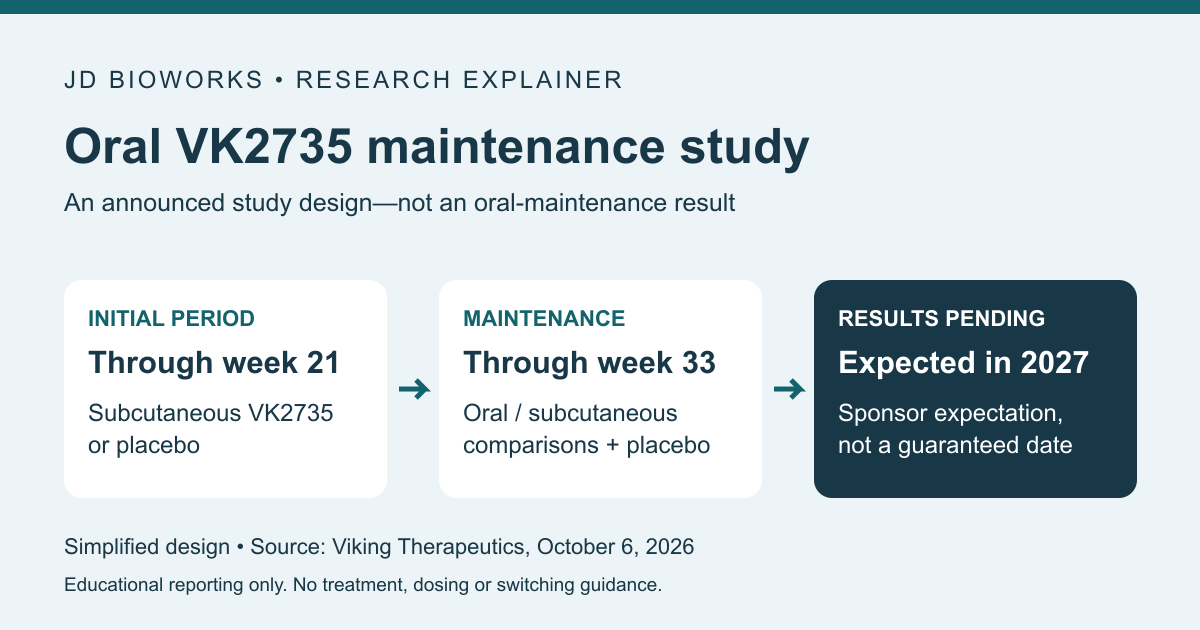
The sponsor describes a randomized, double-blind, placebo-controlled study in approximately 195 otherwise healthy adults with obesity. Its design has an initial 21-week period using subcutaneous VK2735 or placebo, followed by comparisons of oral and additional subcutaneous maintenance regimens, including placebo, through week 33. Week 33 is the overall study time point—not 33 weeks of maintenance. The stated objectives include safety, tolerability and pharmacokinetics—how the compound behaves in the body. Body-weight changes are exploratory endpoints. These are plans reported by the sponsor, not completed outcomes. Study-design source.
Does the earlier maintenance news prove the oral approach works?
No. The announcement identifies this as Part 2 of a two-part maintenance study. The earlier Part 1 news concerned subcutaneous regimens. Findings from that part cannot establish the outcome of an oral comparison that has not yet reported results. Viking’s description of the two parts.
When reading a headline, check the formulation, study part and endpoint. “VK2735 results” alone is not specific enough to identify the evidence.
Is this the same trial as VANQUISH-1?
No. The ClinicalTrials.gov record for VANQUISH-1, NCT07104500, describes a separate Phase 3 subcutaneous study. It is not the registry record for the oral maintenance comparison announced on October 6. A phase or registration number belonging to one study should not be attached to another merely because both involve VK2735.
We have not verified a matching registry record for the newly announced oral maintenance comparison. This article therefore does not assign it an NCT number or infer its phase from news coverage.
What should readers look for when results arrive?
Look for separate oral-arm results, the comparison group, participant counts, follow-up duration, withdrawals and adverse events. Also check whether the reported finding concerns an exploratory endpoint and whether the full methods are available. An average change should not be described as something every participant experienced.
Viking anticipates reporting Part 2 results in 2027. That is a sponsor expectation, not a guaranteed publication date or a prediction of success. Until results are available, the accurate takeaway is that oral maintenance is being investigated. Original announcement and forward-looking-statement notice.
For more source-linked explanations, visit the JD BioWorks Research Library. We distinguish trial plans from results and do not use a development announcement to substantiate a commercial research material’s performance.
Educational research reporting only; not medical advice. This article provides no dosing, treatment, switching or self-experimentation guidance. JD BioWorks materials are for qualified laboratory research, not human or veterinary use.