
Can Four Amino Acids Act as a Catalyst? What Peptide Research Shows
Yes—some four-amino-acid peptides have acted as catalysts in laboratory studies. That does not mean every tetrapeptide has this ability. A new SwRI–UT San Antonio project will search for additional candidates; its October 6 announcement describes planned research, not a newly validated catalyst. Original tetrapeptide experiment; project announcement.
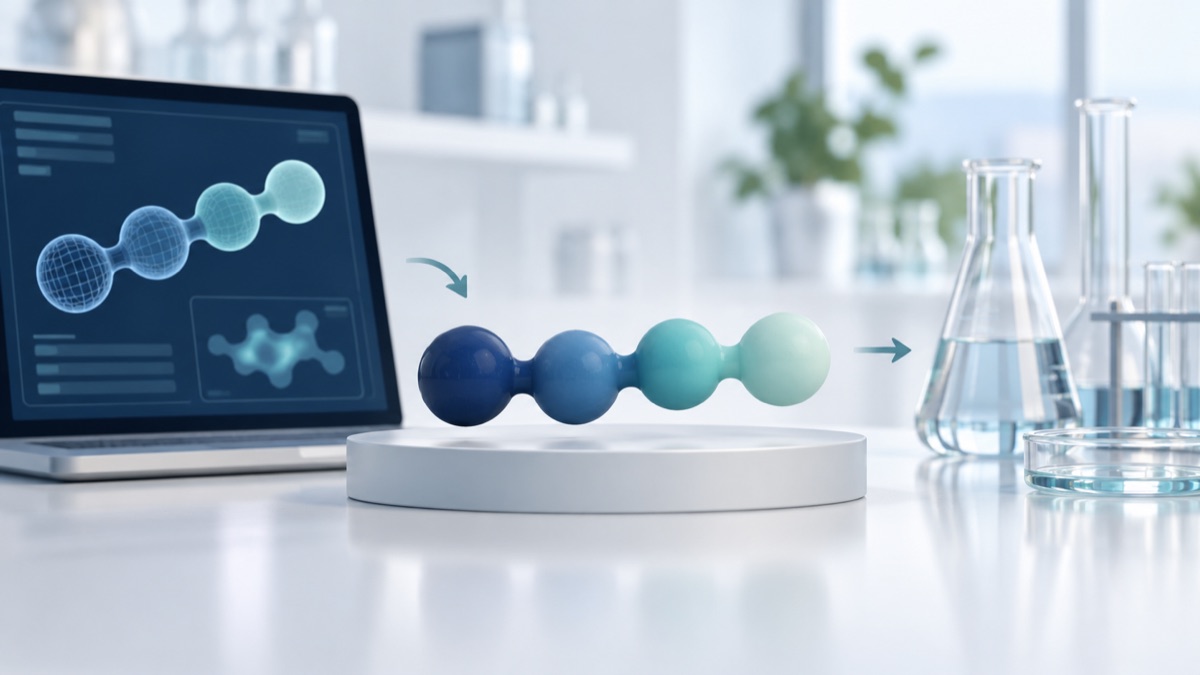
Peptides are often discussed as biological signals or drug candidates. This story asks a different question: can a short peptide help chemists carry out a reaction?
What is a peptide catalyst?
A catalyst increases a reaction’s rate. It participates in the process without changing the reaction’s overall standard Gibbs energy change; IUPAC’s definition describes it as both a reactant and a product. In practical reading, “catalyst” is a claim about a chemical reaction—not another word for a medicine, supplement or ingredient. IUPAC Gold Book.
A tetrapeptide contains four amino-acid residues. Knowing its length is only a starting point: a useful catalyst still needs evidence about its particular structure and the reaction being studied. The new project’s focus on tetrapeptides does not establish that any four-residue commercial material will perform the same function. SwRI project announcement.
What earlier tetrapeptide experiments found
In a 2022 peer-reviewed study, Liu and colleagues examined nine related tetrapeptide sequences in a model aldol reaction—a reaction that forms a carbon–carbon bond. They changed the two internal residues and measured structural characteristics, reaction rate and stereoselectivity. Stereoselectivity concerns which spatial forms of the product are favored. Original ACS Omega paper.
The researchers found a rough relationship between their structural indicator and reaction rate, but little variation in stereoselectivity among the sequences with available data. They could not obtain selectivity data for three of the nine sequences. Faster reaction and more selective reaction are separate outcomes; evidence for one should not be presented as evidence for both. These findings concern those sequences and experimental conditions, not the new SwRI project or JD BioWorks materials. Original results and conclusions.
What the new SwRI–UT San Antonio project will test
The collaborators plan to adapt SwRI’s Rhodium computational platform to identify promising tetrapeptide catalysts. UT San Antonio researchers would then test the candidates in the laboratory. The announcement frames the work around organic-molecule synthesis and says it will not advance pharmaceuticals themselves. October 6 institutional announcement.
The distinction is important: a computational candidate is a prediction worth investigating. Laboratory measurements are needed before describing it as a successful catalyst. Hopes for more efficient or sustainable synthesis are goals of this project, not demonstrated outcomes reported in the announcement.
How to judge the next set of results
A useful reading checklist separates three questions:
- What was predicted? Identify the proposed peptide and reaction, rather than treating a screening score as measured performance.
- What was measured? Look for experimental comparisons, the stated conditions, and separate reporting of rate and selectivity.
- What is the scope? Ask whether the conclusion concerns one reaction or a broader set, and whether the evidence has been published with methods and limitations.
This is a document-reading framework, not a laboratory protocol. The 2022 study illustrates why controls and distinct measurements matter: its structural correlation did not translate into an equally clear selectivity trend. Original study.
For related reading, our HPLC versus LC-MS guide explains how analytical methods answer different questions. The research peptide documentation checklist helps connect a material’s identity and lot records with the evidence supplied.
Is this a new GLP-1 treatment study?
No. The announcement mentions the wider interest in peptides, but the work described is catalyst-discovery chemistry. It is not a human weight-loss trial and does not report a new treatment or an approval. Keep that boundary in mind when headlines place all peptide research in the same category. SwRI announcement.
Continue with the JD BioWorks Research Library for source-linked explanations that distinguish a research question from a demonstrated result.
Educational chemistry research coverage only. JD BioWorks materials are for qualified laboratory research, not human or veterinary use. This article provides no treatment, dosing or self-experimentation guidance and does not establish the performance of any commercial product.