
503A vs 503B Peptides and What a Prescription Means
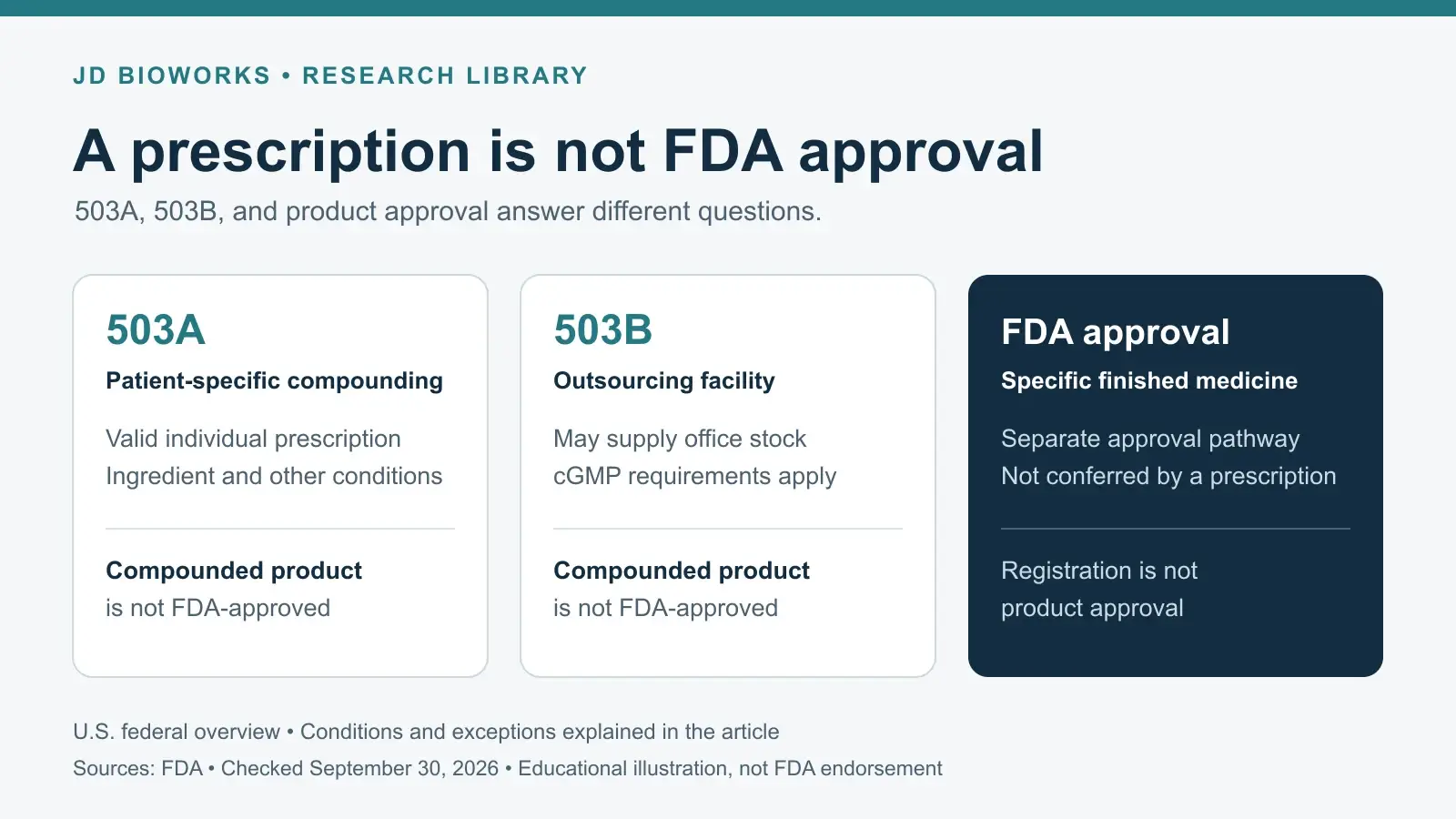
U.S. federal framework checked September 30, 2026.
A prescription is not an FDA approval, and a pharmacy's registration is not permission to compound every peptide.
Sections 503A and 503B describe different pathways for certain compounded medicines. Neither turns a compounded product into an FDA-approved drug. Compounding can meet a genuine medical need, but an individual prescription is only one part of the applicable requirements. FDA compounding questions and answers.
That distinction matters when a clinic, telehealth service, or website describes a peptide as “prescription,” “pharmacy-grade,” or “from an FDA-registered facility.” The useful question is not simply whether a doctor is involved. It is what exact product is being supplied, who made it, and what requirements apply to it.
What changed on October 30, 2026?
On October 30, 2026, HHS published a notice of availability for its peptide-compounding enforcement-discretion policy. The published notice describes a draft policy addressing certain bulk drug substances under Section 503A while rulemaking continues. This is separate from the July advisory recommendations and does not mean that these peptides or compounded preparations are FDA-approved. Read the published notice and complete HHS document together, including their conditions and limitations.
Historical status note – October 16, 2026
Has FDA issued a new peptide-compounding policy?
Review-status check: October 16, 2026. The Office of Information and Regulatory Affairs lists Interim Access Policy for Compounding Using Certain Peptides as a pending regulatory review. Its record identifies FDA as the agency, gives October 14, 2026 as the received date, and labels the stage “Notice” (RIN 0910-ZD94). Read the official pending-review record.
The record does not supply the policy text, a peptide list, or an effective date. This is a report of that filing’s status—not an announcement of FDA product approval or a conclusion that a particular peptide can now be compounded. The existing framework explanation below remains dated to its stated September 30 check.
What is the difference between 503A and 503B?
Both numbers refer to sections of the Federal Food, Drug, and Cosmetic Act—not two levels of FDA product approval.
| Question | Section 503A | Section 503B |
|---|---|---|
| Who compounds the medicine? | A licensed pharmacist in a state-licensed pharmacy or federal facility, or a licensed physician | A licensed pharmacist, or someone under that pharmacist's direct supervision, in an outsourcing facility |
| Is an individual prescription required? | A valid prescription for an identified patient; limited anticipatory compounding is possible under conditions | The facility may supply patient-specific prescriptions or office stock without an identified patient's prescription |
| Do federal current good manufacturing practice requirements apply? | An exemption is available only when all 503A conditions are met | Yes; 503B does not provide that exemption |
| Does this make the compounded drug FDA-approved? | No | No |
Sources: FDA's comparison of the statutory requirements and FDA's explanation of compounding law.
The office-stock distinction concerns how a facility supplies medicine. It should not be read as a blanket exemption from patient-care, prescribing, or state requirements.
FDA describes state boards of pharmacy as having primary responsibility for oversight of state-licensed pharmacies operating under 503A, although FDA also inspects some of these facilities. FDA has primary responsibility for outsourcing facilities, which are inspected on a risk-based schedule. Different oversight does not establish that every product from one category is safer than every product from the other. FDA compounding questions and answers.
Why doesn't a prescription settle the question?
A prescription answers who ordered the medicine for a patient. It does not, by itself, answer whether the ingredient is eligible for the claimed compounding pathway or whether the compounder meets the remaining requirements.
FDA explains that the exemptions in 503A and 503B depend on satisfying all applicable conditions. Drugs that do not qualify remain subject to the requirements that apply to conventionally manufactured drugs. The agency's comparison is not an exhaustive account of every condition. FDA statutory comparison.
For readers, that means separating three questions:
- Product approval: Is this exact finished medicine FDA-approved?
- Compounding basis: If it is compounded, what current pathway and ingredient rules apply?
- Evidence: What supports the specific benefit being advertised?
A confident answer to one question does not resolve the other two.
Which ingredients can be used under 503A?
When a compounder starts with a bulk drug substance—the active ingredient rather than an already finished medicine—503A has a specific sequence of ingredient requirements.
The substance must meet an applicable United States Pharmacopeia or National Formulary monograph, if one exists, and the relevant USP compounding chapter. If there is no applicable monograph, it must be a component of an FDA-approved drug. If neither route applies, it must appear on the FDA-developed 503A bulks list.
The bulk ingredient also needs a valid certificate of analysis and must come from a manufacturer registered under the applicable federal provision. These requirements are not replaced by the prescriber's willingness to write a prescription. FDA's 503A bulk-substance explanation.
Why are the 503B ingredient rules different?
For compounding from bulk under 503B, the ingredient generally must appear on FDA's clinical-need bulks list, or the drug made from it must be on FDA's drug-shortage list at the time of compounding, distribution, and dispensing.
There are also requirements for a valid ingredient certificate of analysis, a registered manufacturer, and compliance with an applicable recognized monograph. Being an ingredient in an approved drug is not, by itself, the same 503B route that it can be under 503A. FDA's 503B bulk-substance explanation.
So “our supplier is 503B” is not a complete answer to whether that supplier can compound a particular peptide from bulk.
What do FDA’s 503A Categories 1, 2 and 3 mean?
FDA also has interim enforcement policies while it evaluates certain nominated substances. Under specified conditions, the agency says it does not intend to take action for substances in Category 1. Category 1 is not final-list inclusion or product approval.
Category 2 concerns identified significant safety risks; Category 3 concerns insufficient supporting information. Neither receives the Category 1 policy. These are enforcement-policy distinctions, not three grades of FDA-approved medicines. FDA's January 2025 503A interim guidance, FDA's 503B interim-policy explanation.
An advisory committee recommendation is another separate step. FDA's July 2026 peptide meeting concerned substances under consideration for the 503A list. FDA explicitly describes advisory recommendations as nonbinding. A recommendation about 503A therefore should not be described as a 503B authorization or FDA drug approval. FDA's July meeting record.
For that meeting's background, see our FDA peptide compounding vote explainer.
Where do BPC-157 and TB-500 fit?
As of this article's September 30 check, neither BPC-157 nor TB-500 appeared in the final 503A list in 21 CFR 216.23 or FDA's published 503B bulks list.
FDA's current safety page discusses both under substances whose nominations were withdrawn. For BPC-157, it identifies concerns about immune reactions, peptide impurities, and ingredient characterization, with insufficient safety information. For TB-500, the page identifies the thymosin beta-4 fragment LKKTETQ and describes limited information about human safety. That identity matters: a trade name alone is not enough to establish which substance is being offered. FDA's bulk-substance safety information.
Do not turn these findings into a claim that every clinic is breaking the law. But do not treat “my doctor prescribed it” or “the committee voted on it” as proof of a valid compounding basis either. Ask the provider and dispensing pharmacy to identify the exact formulation and the current basis they rely on. A case-specific legal assessment needs more information than a product's marketing name.
Even final-list inclusion is not FDA endorsement of a medicine: the 503A regulation expressly warns against representing listed-substance compounded products as FDA-approved or endorsed. 21 CFR 216.23.
What about semaglutide, tirzepatide, and newer compounds?
An ingredient's presence in an FDA-approved product does not make every compounded version unrestricted.
FDA's April 1, 2026 clarification explains the 503A restriction on regularly or excessively compounding products that are essentially copies of commercially available drugs. A documented prescriber determination that a change produces a significant difference for an identified patient is relevant; simply calling a product “personalized” is not the same thing.
The same update explains that adding another ingredient, such as vitamin B12, does not automatically avoid the copy restriction. It also states that semaglutide and tirzepatide were not on the 503B bulks list or FDA's shortage list at that update. These are dated statements, not a promise that shortages or policies can never change. FDA's GLP-1 compounding clarification.
The FDA also warns that some unapproved GLP-1-related compounds are not lawful ingredients for compounding. Consult FDA's current statement about unapproved GLP-1 drugs for its named substances and scope. That statement concerns compounding; it should not be confused with access in an authorized investigational study.
Is “off-label” another name for an unapproved peptide?
No. FDA's explanation of off-label prescribing starts with an FDA-approved drug. A health care provider may generally prescribe that approved drug for an unapproved use when medically appropriate, although FDA has not determined its safety and effectiveness for that use.
That is different from saying that any unapproved research chemical becomes an approved medicine when prescribed. Off-label use, compounded medicines, and investigational drugs are different categories and should not be blended together in a sales explanation. FDA's off-label explanation.
Does “FDA-registered” mean the facility or drug is approved?
No. FDA says outsourcing-facility registration means the agency received the required registration information. It does not mean the facility is FDA-approved, that it complies with current good manufacturing practice, or that all its products satisfy the conditions for 503B exemptions.
Registration and an inspection also do not establish that every future batch will comply. FDA's outsourcing-registration questions and answers.
Ask for the facility's exact name and location—not only the clinic's brand—and compare it with FDA's registered outsourcing-facility directory. The directory includes registration, inspection, recall, and related action information; those fields require context rather than a simple “approved” badge.
What does a COA prove?
A certificate of analysis documents specified tests and results for the material identified in the report. It does not confer FDA approval or, by itself, establish that a finished medicine qualifies for a compounding exemption.
For example, a chromatographic purity result is not a sterility result. Our guide to what peptide tests can and cannot show explains why identity, purity, quantity, sterility, and endotoxin are separate questions.
FDA requires a valid COA for bulk ingredients under both pathways, but its ingredient rules contain additional conditions. “We have a COA” is therefore a starting point for documentation—not the entire regulatory answer. FDA statutory comparison.
Can a clinic make medical claims because a doctor is involved?
Medical claims still need evidence. The FTC's health-products guidance says claims about health benefits and safety require appropriate scientific substantiation. Testimonials are not a substitute, and animal or laboratory findings alone do not establish a claimed benefit in people.
Ask whether the cited evidence concerns the same substance, formulation, population, and outcome being advertised. A study of one ingredient does not necessarily substantiate a claim about a combination product. FTC health-products compliance guidance.
Seven questions to ask before accepting a peptide explanation
Use these questions to request specifics, not to diagnose yourself or decide a clinic's legal status from a checklist.
- What is the exact product? Request the ingredient name, chemical form, formulation, and maker—not just “BPC,” “TB,” or a blend nickname.
- Is the finished medicine FDA-approved or compounded? If approval is claimed, ask for the exact product and its FDA approval record.
- Who actually made it? Obtain the dispensing pharmacy or outsourcing facility's name and physical location.
- Which framework applies? Ask whether the provider is relying on 503A, 503B, or a separate investigational pathway, and what current ingredient basis applies.
- What is the patient-specific rationale? For 503A, ask how the prescription and, where relevant, any significant-difference determination relate to your specific circumstances.
- What documentation supports quality? Ask which records concern the ingredient and which concern the finished preparation. Do not substitute a purity percentage for every other quality question.
- What supports the advertised benefit? Request original human evidence and a clear explanation of its limitations rather than testimonials or a social-media summary.
These questions help reveal whether a provider is explaining the actual product or relying on reassuring labels.
Research-use materials are not an alternative prescription route
FDA has warned about products falsely labeled for research while being sold for human use with dosing instructions. A research-only label does not resolve that conflict. FDA's unapproved GLP-1 warning.
JD BioWorks supplies research materials for qualified laboratory use, not prescription treatment. This guide is not an invitation to replace prescribed medicines with research products.
The takeaway is straightforward: verify the product, the maker, the applicable pathway, and the evidence separately. A prescription, a registration, a COA, and an advisory vote each answer different questions.
This article explains publicly available U.S. federal information as checked on September 30, 2026. It is not individualized medical or legal advice, a determination about any particular provider, or an exhaustive account of federal and state requirements. Regulations, lists, and enforcement policies can change. JD BioWorks research products are not for human or veterinary use.