
JD BioWorks Research Resources
Research Library
Source-conscious guides to analytical methods, documentation, compound literature, regulatory developments, and evidence interpretation.
Browse articles by month, topic, or compound
Filtered Research
11 articles
What Did FDA Approve About Mimrylo (Rusfertide)?
FDA approved Mimrylo, the branded rusfertide medicine, after the phase 3 VERIFY trial. The approval is important—but product-specific.
Read article
Is Ipamorelin Banned in Sport? What the 2026 WADA List Says
WADA's 2026 Prohibited List expressly names ipamorelin under class S2 and prohibits it in and out of competition. Here is what that rule—and a recent provisional cycling suspension—actually means.
Read article
Did Avexitide Reduce Hypoglycemic Events by 55%? What the Phase 3 LUCIDITY Results Actually Show
A review of sponsor-reported Phase 3 LUCIDITY findings, the 55% relative event-rate reduction, safety reporting, and evidence limits.
Read article
Is Zenagamtide in Phase 2 Human Trials? What the 2026 Data Actually Show
A review of oral and subcutaneous zenagamtide reports from one Phase 2 study, including the study population, outcomes, and limitations.
Read article
What Is TFA in Synthetic Peptides—and Why Is It on a COA?
Learn how TFA and peptide counterions affect material composition—and why HPLC purity, peptide content, and total vial mass are different measurements.
Read article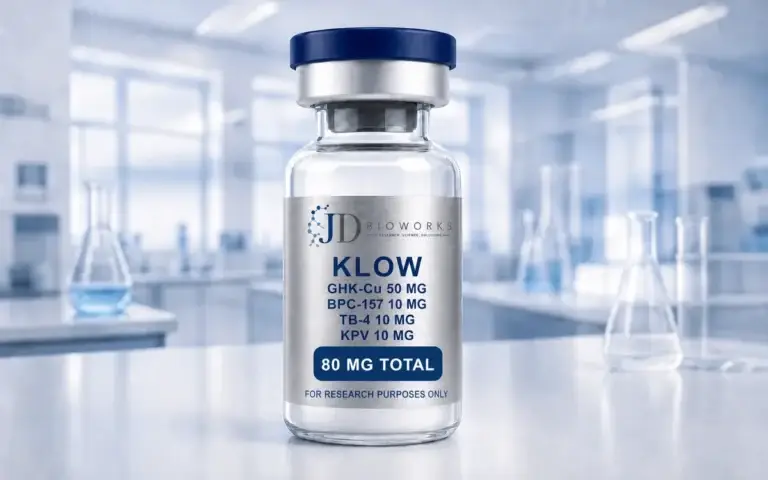
How to Read a Multi-Peptide Blend COA: KLOW 80 mg
A field-by-field guide to the KLOW 80 mg lot 2026-002 Certificate of Analysis, including HPLC purity, identity, component quantitation, net blend content, terminology, and report limitations.
Read article
MOTS-MET Trial Record: What NCT07505745 Shows—and What It Does Not
A Phase 2a MOTS-c study is listed as recruiting on ClinicalTrials.gov. Here is what the registry confirms—and what it does not prove.
Read article
The FDA Received 990 Reports About Compounded Semaglutide—But Social Media Is Reading the Number Wrong
FDA received 990 adverse-event reports associated with compounded semaglutide. Learn what the number shows—and why it does not prove causation or risk.
Read article
How Should Lyophilized Research Peptides Be Stored?
Learn how temperature, moisture, light, oxygen, and freeze-thaw cycles affect lyophilized research peptides—and why storage must be peptide-specific.
Read articleRESEARCH RESOURCE PATHWAY
Compound research evidence library
Browse research-only literature overviews organized by exact compound name. Each page separates reported findings from analytical identity and evidence limitations.
BPC-157 research evidence
A source-conscious overview of preclinical evidence and study limitations.
GHK-Cu research evidence
Research context for GHK-Cu, terminology, methods, and study limitations.
KPV research evidence
Research context, sequence identity, documentation, and evidence limitations.
MOTS-C research evidence
Research context for a mitochondrial-derived peptide and its documentation needs.
PT-141 research evidence
A research-only review of nomenclature, identity, literature, and limitations.
Selank research evidence
Research context, peptide identity, sourcing records, and evidence limits.
TB-500 research evidence
Clarify nomenclature, sequence claims, laboratory identity, and source limitations.
Tesamorelin research evidence
Research context, identity documentation, analytical methods, and evidence limits.
RESEARCH RESOURCE PATHWAY
Research and editorial standards
See how sources, corrections, and document revisions are handled.
Scientific sourcing and editorial standards
How JD BioWorks selects sources, distinguishes evidence levels, and updates research content.
Corrections and document revision policy
How factual corrections, material updates, and superseded records are handled.
START WITH THE RESEARCH QUESTION